Skip to content

A splash pad that looks huge in a product photo can feel surprisingly crowded once two children start running through the spray. That happens because the diameter printed on the package tells only part of the story. The outer sprinkler ring occupies some of the footprint, children rarely stay in one place, toys take up space, and the hose connection affects where everyone can move. A pad that technically fits three children may therefore feel much smaller during active play.
For most families, 5–8 ft works well for one young child, 8–10 ft is a practical range for one or two children, 10–12 ft gives two to four active children more comfortable movement space, and 13–16 ft makes more sense for larger groups, regular playdates, pets, or spacious yards. The best choice depends on users, activity level, usable play area, yard space, water supply, and storage.
There is also a practical side that product photos rarely show. A 16 ft splash pad may sound like the safest choice because nobody wants to buy too small, but it occupies more than 200 square feet of gross circular area before surrounding clearance is considered. That extra surface has to be positioned, supplied with water, drained, dried, folded, and stored after use. The goal is not to find the biggest pad within your budget. It is to find the size your family will be happy to bring out again and again.
What Size Splash Pad Should I Buy?
For most households, begin with 5–8 ft for one young child, 8–10 ft for one or two children, 10–12 ft for two to four active children, and 13–16 ft for larger groups. Treat these as practical shopping ranges rather than fixed capacity rules. Activity level, usable center space, yard clearance, water flow, drying space, and how often the pad will be used should influence the final choice.
Match Size to Real Use
A useful splash pad size starts with the way children actually play rather than the maximum number of people who could stand on the surface. One toddler sitting near the center with cups and water toys needs far less movement space than two school-age children who run from one side to the other, chase spray streams, and repeatedly step on and off the perimeter. The same listed diameter can therefore feel spacious in one household and cramped in another.
Compact 5–6 ft models make the most sense for one toddler, a young preschooler, or a smaller patio where easy handling matters. An 8–10 ft pad gives one active child more freedom and generally works better for two younger siblings. Moving into the 10–12 ft range creates a much more flexible family play area, especially when two to four children use the product together and need space to move independently.
Sizes around 13–16 ft become useful when several children regularly play at once, older children need more running space, neighborhood friends visit frequently, or the family expects children and pets to share the pad. At that point, available lawn space and cleanup convenience become just as important as the diameter itself. A larger product can be a better experience, but only when the yard and household routine can support it comfortably.
| Splash Pad Diameter | Approx. Gross Circular Area | Typical Household Fit |
|---|---|---|
| 5 ft | 20 sq ft | One toddler |
| 6 ft | 28 sq ft | One young child |
| 8 ft | 50 sq ft | One active child or two toddlers |
| 10 ft | 79 sq ft | Two children |
| 12 ft | 113 sq ft | Two to four children |
| 13 ft | 133 sq ft | Several children or frequent guests |
| 16 ft | 201 sq ft | Large family or group play |
The figures above describe total footprint rather than unrestricted play area. The water-filled perimeter, welded edge, hose connection, and any raised play features take up some of that space, so children will not have the full calculated area available for movement. That distinction becomes increasingly important when comparing two products with similar advertised dimensions.
Count Active Users
Counting children is useful, but counting active children gives a more realistic answer. Two toddlers may spend most of a session sitting or kneeling and can often share a moderate-size pad comfortably. Two seven-year-olds may use several times more effective movement space because they run across the center, turn quickly, jump between spray streams, and bring additional games onto the surface.
Mixed-age households make this difference particularly noticeable. If a three-year-old and an eight-year-old will use the pad together, sizing around the older child usually produces a better result. The younger child benefits from extra room, while the older child is less likely to feel restricted. Water flow can usually be adjusted through the faucet, allowing the spray to remain gentle enough for younger children even when the pad itself is larger.
The same logic applies to occasional guests. A household with two children does not necessarily need a group-size splash pad simply because friends visit twice a year. However, if cousins or neighbors join almost every weekend, choosing one reasonable size above the minimum can prevent the pad from feeling overcrowded and may provide better value over several summers.
Think about the busiest normal session rather than the largest party you could possibly host. That keeps the product large enough for real family life without creating unnecessary setup, drying, and storage work during the rest of the season.

Balance Space and Convenience
Increasing diameter creates more area faster than many shoppers expect. A 10 ft circular splash pad has a gross footprint of approximately 79 square feet, while a 16 ft pad covers about 201 square feet. The larger pad is only 60% wider in diameter, yet it occupies more than two and a half times the surface area. That difference affects children’s movement, but it also affects everything adults have to do before and after play.
More PVC surface means more water remaining on the product after use, more space required for air drying, and a larger folded bundle to store. For families that use their splash pad several times each week, these practical differences can determine whether the pad becomes part of the summer routine or stays folded in a garage because setting it up feels like too much work.
Water delivery also deserves consideration as sizes increase. Spray performance depends on faucet flow, garden-hose length and diameter, connector restriction, spray-hole quantity, hole diameter, and the design of the perimeter ring. A larger product does not automatically produce taller or more impressive spray, particularly when connected through a long, narrow, or partially kinked hose.
The best size is therefore usually the smallest one that still gives regular users comfortable movement and some sensible room for growth. Everyday usability is more valuable than impressive dimensions that make the product unnecessarily difficult to handle.
Which Splash Pad Size Fits My Kids?
Choose splash pad size by combining the number of children with their ages and activity levels. One toddler may be comfortable on 5–6 ft, two younger children often fit better on 8–10 ft, and two to four active children usually benefit from 10–12 ft. Larger groups may need 13 ft or more, especially when older children run, jump, use toys, or play games across the pad.
One Child
For one toddler, diameter should not be the first priority. A 5–6 ft pad can provide enough space for sitting, crawling, standing, pouring water, and exploring the spray without occupying a large part of the yard. Compact sizes are also easier for adults to position, rinse, dry, and store, which can make them especially practical for patios, narrow lawns, or households that expect to use the product frequently.
Once children become more mobile, space requirements change quickly. A preschooler who spends most of the session walking around the perimeter and stepping repeatedly through the spray uses much more surface than a toddler sitting near the center. Moving toward 6–8 ft often gives one active young child noticeably more freedom without making the product unnecessarily large.
Older children who enjoy running, jumping, kicking soft balls, or creating simple water games may appreciate 8–10 ft even when they are the only regular user. The extra space is not about leaving a large empty area around one child. It allows normal movement without constantly reaching the perimeter ring or hose connection.
Age labels alone are therefore a poor sizing tool. Two five-year-olds can have completely different play styles. Think about how the child normally uses outdoor space, then choose enough diameter for that behavior rather than simply following the minimum age printed on a package.
Two Children
Two children often need noticeably more space than parents expect because each user requires room not only to stand but also to move around the other. An 8 ft circle provides roughly 50 square feet of gross footprint, while a 10 ft circle provides about 79 square feet. Increasing diameter by only two feet therefore adds roughly 29 square feet of total surface, which can create a very noticeable difference during active sibling play.
For two toddlers or younger preschoolers, an 8 ft pad can be a sensible choice. When both children are active runners, 10 ft usually provides more comfortable separation. Families with two older or especially energetic children may find 10–12 ft better suited to the way they actually play, particularly if balls, buckets, water toys, or other accessories regularly occupy part of the center.
Age differences matter as well. A two-year-old sitting with toys and a seven-year-old running through the jets create a very different traffic pattern from two toddlers. In mixed-age households, choosing around the more active user helps prevent constant crossing and crowding while still leaving the younger child a comfortable place to play.
Future growth can justify moving up one category when the current size is already close to its comfortable limit. It does not mean buying the largest possible pad. A modest step from 8 ft to 10 ft or from 10 ft to 12 ft often creates meaningful additional room without dramatically increasing the demands on the yard.

Three or More Kids
Three or more children turn splash-pad use into group movement rather than individual water play. One child may sit in the center while another runs around the edge and a third repeatedly enters and leaves the spray. As toys are added and children begin inventing games, open space disappears faster than simple user-count labels suggest.
For three to four children, 10–12 ft is a useful starting range. A 12 ft circle offers approximately 113 square feet of gross footprint, more than twice the area of an 8 ft model. This additional surface gives children more opportunity to occupy separate parts of the pad instead of competing for the same spray zone or constantly crossing one another’s paths.
Households expecting five or more active children on a regular basis may benefit from 13–16 ft when they have a genuinely open yard. Capacity should still be treated as flexible. Five toddlers, five six-year-olds, and three children sharing the pad with two dogs place very different demands on the product even though the simple headcount may appear similar.
Repeated group use also makes construction more important. More feet cross the perimeter, the material experiences more folding and dragging, and the spray ring is stepped on more frequently. PVC gauge, welding consistency, surface texture, connector stability, and perimeter design all become more relevant as both size and user count increase.
For larger family-use products, EPN considers diameter alongside PVC thickness, welding layout, spray distribution, hose connection, and surface structure rather than treating size as an isolated specification. That same approach is useful for shoppers: a larger diameter is most valuable when the rest of the product is designed to support the intended level of use.
How Much Yard Space Do I Need?
Plan for more outdoor space than the splash pad’s listed diameter. As a practical household planning range, leaving roughly 2–3 ft of open space around the pad makes entry, supervision, spray clearance, and hose routing easier. A 10 ft pad therefore feels more comfortable in about 14–16 ft of clear width, while a 12 ft pad generally benefits from roughly 16–18 ft.
Measure the Clear Area
Measure the part of the backyard that can actually be used, not the total dimensions shown on a property plan. Fences, patio furniture, stairs, trees, planters, grills, storage boxes, landscape borders, exposed roots, and uneven ground can remove several feet from what initially looks like a large open area.
A lawn might measure 20 ft from one side to the other yet have only 14 ft of uninterrupted flat space after furniture and landscaping are considered. That difference can determine whether a 12 ft splash pad feels comfortable or leaves almost no room for children to enter, adults to move around the perimeter, or the hose to reach the connector without crossing the play area.
Before ordering, mark the proposed diameter on the ground. A garden hose, string, chalk, or a few lightweight objects can outline the size well enough to understand its real footprint. Once the outline is visible, walk around it rather than simply looking at it from a distance.
Check where children are likely to enter, where an adult might stand, and whether spray could reach doors, cushions, electrical equipment, or frequently used walkways. This simple physical test often reveals more than product photography because it places the dimensions directly into the space where the splash pad will actually be used.
Leave Useful Clearance
A splash pad’s working footprint is larger than its PVC footprint. Children run off the wet surface, stop beside the jets, retrieve toys, and return from several directions. Adults may need to adjust the hose or help a younger child without stepping across the most active part of the play area.
Where the yard allows, around 2–3 ft of surrounding open space is a useful residential planning margin. This is not a building code or universal safety requirement; it is a practical way to prevent the pad from being squeezed against furniture, fences, steps, walls, or other obstacles that make movement less comfortable.
| Pad Diameter | Gross Circular Area | Useful Clear-Width Target |
|---|---|---|
| 6 ft | 28 sq ft | About 9–10 ft |
| 8 ft | 50 sq ft | About 11–12 ft |
| 10 ft | 79 sq ft | About 14–16 ft |
| 12 ft | 113 sq ft | About 16–18 ft |
| 13 ft | 133 sq ft | About 17–19 ft |
| 16 ft | 201 sq ft | About 20–22 ft or more |
Extra room is particularly useful on the hose-connection side and wherever supervising adults are most likely to stand. If the pad sprays toward windows, furniture, delicate plants, or outdoor electronics, more separation may be needed regardless of the general ranges shown in the table.
Space should never replace supervision. Even when a splash pad holds very little standing water, young children should remain closely watched during water play. A clear setup area simply makes active supervision easier because adults can reach children without navigating around avoidable obstacles.

Check Hose, Surface, and Drainage(图4)
The hose route can make an otherwise well-sized setup inconvenient. If the only way to reach the splash pad is to stretch a hose across the main path children use to enter the yard, the location is probably not ideal. A better setup allows the hose to approach from the side without remaining tightly stretched or repeatedly pulled at the connector.
Longer hoses and restrictive fittings can also influence spray performance. Water flow at the splash pad is affected by faucet output, hose diameter, hose length, bends, kinks, and connectors. When a household already has modest flow, increasing pad size without considering the water path may not deliver the spray height or consistency expected from promotional images.
Drainage deserves equal attention. Water should not routinely collect against a foundation, flow toward a basement entrance, or create a slippery pathway across a frequently used patio. A gentle lawn slope that carries water away from buildings is usually easier to manage and helps the area recover more quickly after play.
Finally, inspect the surface underneath the pad. Smooth grass or another clean, flat surface is preferable to gravel, exposed roots, sharp twigs, rough paving, or coarse landscaping material. Flexible PVC can handle normal family play, but concentrated pressure against a sharp object underneath remains an avoidable source of punctures.
Is Splash Pad Diameter the Real Play Space?
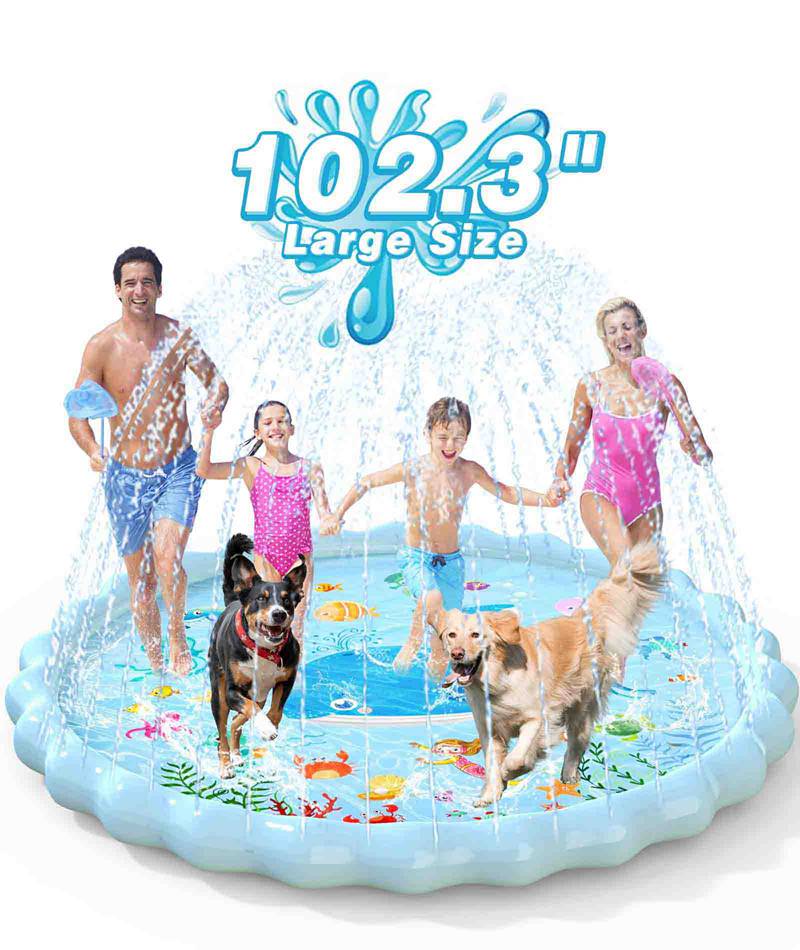
No. The advertised diameter normally describes the outside dimension of the splash pad rather than the completely open play area. The water-filled sprinkler ring, welded perimeter, hose connector, toys, and raised features all occupy part of the footprint. Two pads with the same listed diameter can therefore feel quite different if their perimeter width, accessory layout, or central play area is designed differently.
Overall Size vs Play Area
Overall diameter is still valuable because it tells you how much ground the product occupies, but it should not be interpreted as an equally wide empty play zone. Most flat sprinkler pads use a water-filled perimeter tube that carries water around the edge and feeds the spray holes. That structural ring consumes part of the radius before children even begin playing.
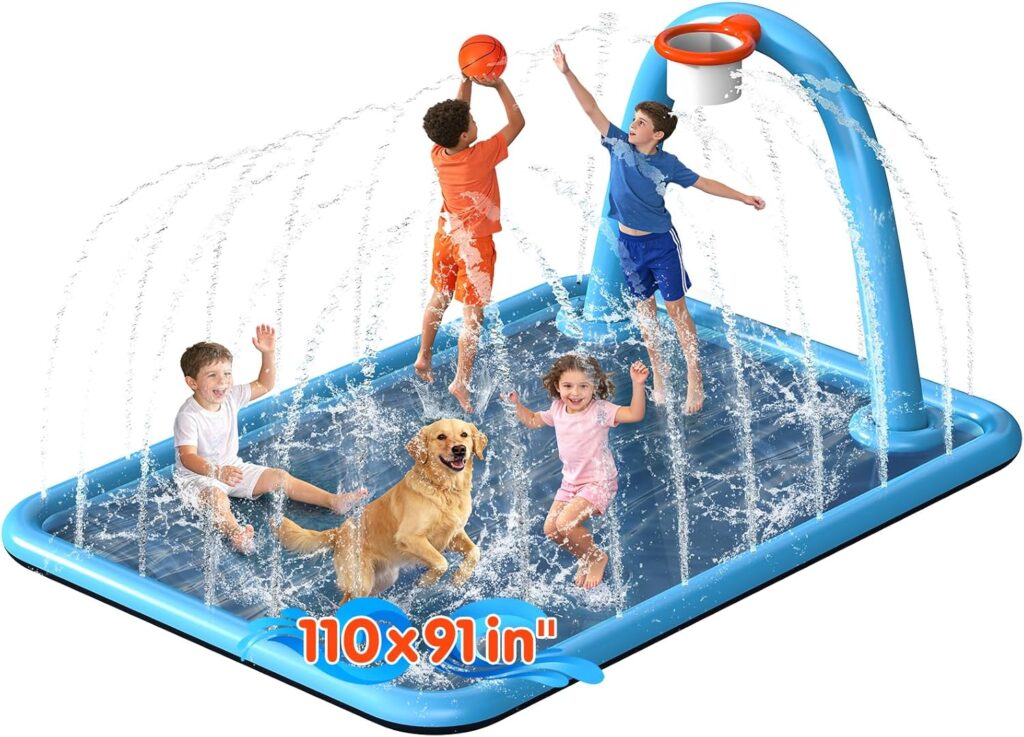
The effect becomes more noticeable on smaller designs. If a perimeter ring takes several inches of width, those inches represent a larger percentage of an 8 ft pad than of a 16 ft pad. Raised hoops, arches, animal figures, ball targets, or other inflatable structures can reduce central space further even though they may add another type of play value.
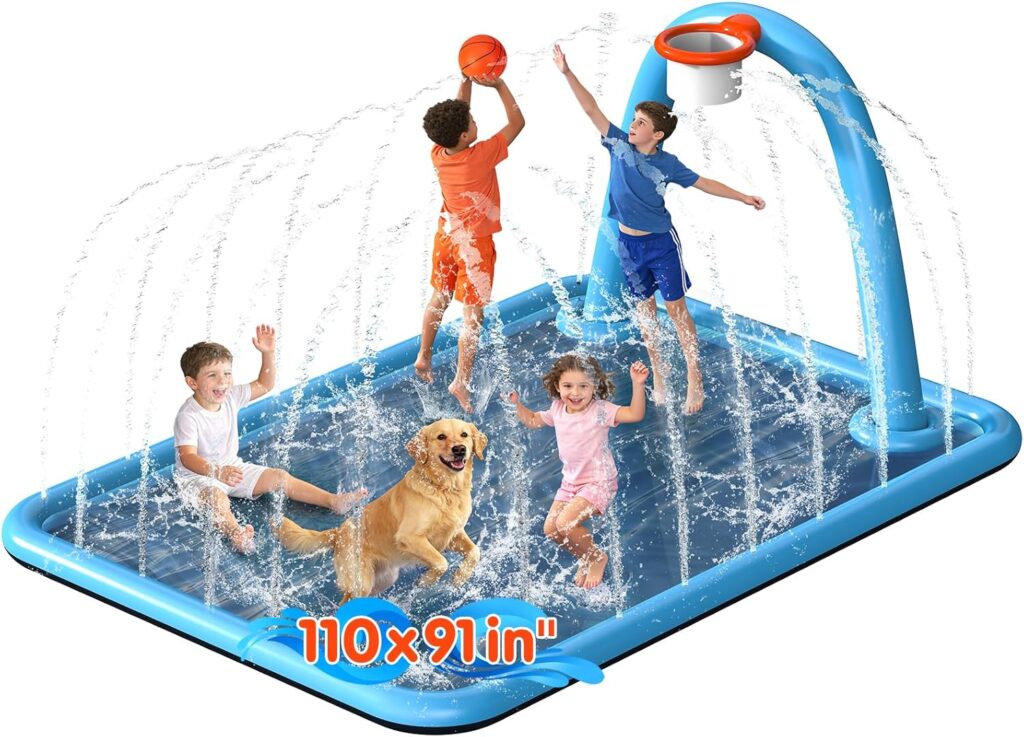
This explains why two products advertised at 100 inches can feel different in a real yard. A simple flat design with a relatively narrow spray ring may provide more open center than another 100-inch model with a wider perimeter and a large basketball structure.
Use the listed diameter to understand whether the product fits the yard. Then look at the layout to judge whether enough of that footprint remains useful for the children who will regularly play there. The combination of diameter and internal layout gives a much better picture than either measurement alone.
Diameter Changes Area Quickly
Diameter is easy to compare because it appears as a single number, but it hides how quickly the total area of a round product increases. Circular area is calculated from the square of the radius, which means a modest increase in diameter can create a surprisingly large increase in gross surface.
| Diameter | Approx. Gross Area | Change vs 8 ft |
|---|---|---|
| 8 ft | 50 sq ft | — |
| 10 ft | 79 sq ft | +57% |
| 12 ft | 113 sq ft | +125% |
| 13 ft | 133 sq ft | +165% |
| 16 ft | 201 sq ft | +300% |
An 8 ft and 12 ft splash pad differ by only four feet in diameter, yet the 12 ft product has more than twice the gross circular area. That is why moving up a seemingly small amount can make sibling play feel noticeably less crowded and provide more room for children to occupy different spray zones.
These numbers should not be turned into a rigid “square feet per child” formula. A toddler sitting in the center uses space differently from an eight-year-old running across the pad, while structural rings and accessories reduce usable area differently from one design to another.
Area calculations are most useful for understanding the scale of the difference between sizes. They help explain why a 12 ft product is not simply a slightly wider version of an 8 ft one and why a small change in diameter can have a significant effect on the overall play experience.

Judge Photos More Carefully
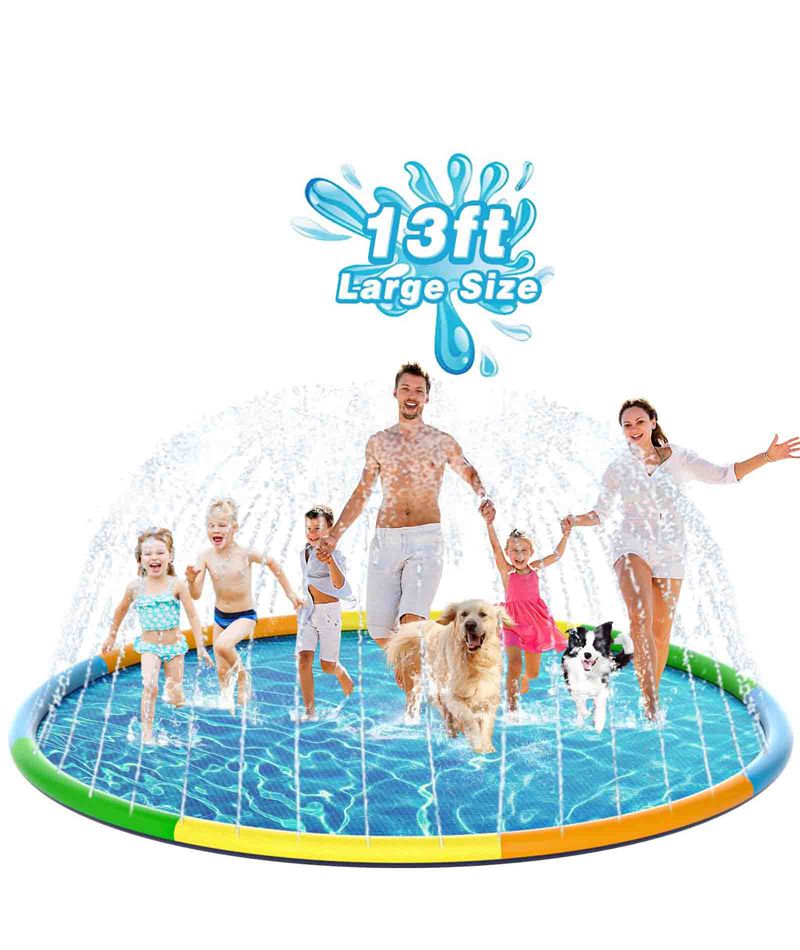
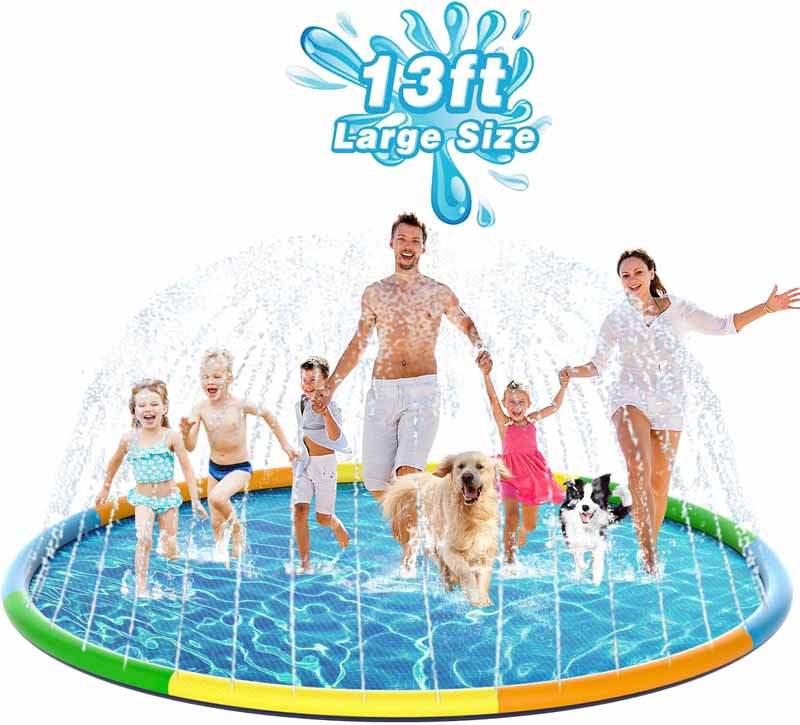
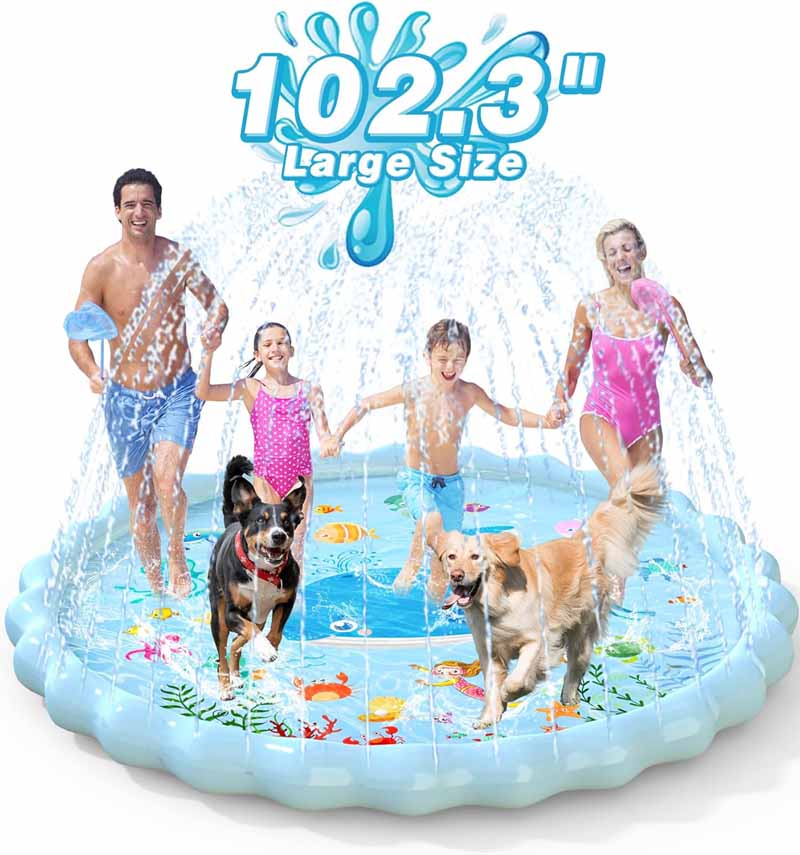
Lifestyle images are helpful for understanding colors, spray direction, and general appearance, but they should not be the only way a family judges dimensions. Lens choice, camera height, cropping, and the height of the children shown in the scene can all change how large a splash pad appears.
A small toddler placed near the center can make an 8 ft model look enormous. A wide-angle lens can increase the apparent distance between the child and the perimeter, while a low camera angle can make it difficult to judge how much surface the sprinkler ring occupies. This does not necessarily make the photograph inaccurate; it simply means visual scale is difficult to assess without measurements.
Convert dimensions into familiar units before comparing products. Sixty inches equals 5 ft, 72 inches equals 6 ft, 96 inches equals 8 ft, 100 inches is about 8.3 ft, 120 inches equals 10 ft, and 144 inches equals 12 ft. Seeing the measurement in familiar units makes product comparisons much easier.
Then mark the diameter on the lawn. This creates a clearer expectation than relying on a staged image. When two products have similar dimensions, compare ring width, center layout, raised features, hose placement, and likely user count rather than assuming identical listed sizes will provide identical usable play space.
Should I Buy a Larger Splash Pad?
Choose the larger size when you regularly expect more children, more active play, growing kids, pets, or frequent guests and your yard can comfortably support it. Moving up one sensible size can improve long-term value, but excessive oversizing adds wet surface, drying time, storage bulk, and potential water-flow demands. The best choice is usually the smallest size that comfortably supports both current and near-future use.

Plan One Stage Ahead
Children’s space requirements change quickly. A toddler who sits quietly in the center this summer may spend the following year running around the spray ring. A younger sibling may begin joining, or a child who previously played alone may start inviting friends over regularly. Choosing exactly enough room for today can therefore leave little flexibility for tomorrow.
When a household is already near the comfortable limit of a size category, moving up one sensible step often works well. One toddler expected to share with a sibling may benefit from 8 ft instead of 5–6 ft. Two active children deciding between 8 ft and 10 ft may get more useful life from the larger option, while a family already using most of a 10 ft surface may find 12 ft worthwhile.
Planning ahead does not mean buying a 16 ft pad for one small child. At approximately 201 square feet of gross area, that product creates far more surface to position, wet, drain, and dry before its full capacity is needed.
Good long-term value comes from repeated use. A pad that is large enough for the next stage but still easy to set up on an ordinary weekday is usually a better choice than a dramatically oversized model kept mainly for occasional events.
Allow for Friends and Pets
Playdates are one of the clearest reasons to consider additional space. A pad that works comfortably for two siblings can become busy when two friends join, especially because group play tends to involve more running, chasing, and movement across the center rather than four children remaining in fixed positions.
For households with regular guests, 10–12 ft often provides useful flexibility. Larger 13–16 ft sizes are better suited to families that genuinely expect several active users at the same time and have enough clear lawn to support the additional footprint and surrounding clearance.
Dogs create another movement pattern. A pet may step through the spray, turn around in the center, lie on the wet surface, or quickly cross a child’s path. Families planning regular kids-and-dog use should therefore allow more open area than a simple child count would suggest.
Material condition becomes more important as shared use increases. Pet nails should be kept trimmed, sharp debris should be removed from underneath the pad, and chewing or rough dragging should be discouraged. PVC thickness, seam quality, surface texture, spray-ring welding, and connector construction deserve additional attention when the pad will experience frequent mixed use.
EPN develops children’s and pet PVC water-play products, so shared-use designs can be considered around material thickness, spray distribution, structural layout, graphics, and intended user mix rather than simply increasing diameter. For families, the same principle applies: size and construction should work together.
Consider Water, Drying, and Storage
A larger splash pad creates a longer sprinkler perimeter, so water must travel through more of the ring before reaching all of the spray holes. Household flow, hose length, hose diameter, connector design, hole quantity, hole size, and spray angle all influence the final water pattern. Diameter by itself does not determine spray height.
A long garden hose may deliver less flow at the pad than a shorter hose connected to the same faucet, particularly if it contains narrow fittings, multiple bends, or partial kinks. Families with modest outdoor water flow should therefore be cautious about choosing a very large pad solely because the yard has enough physical room.
Drying is another practical difference. A 16 ft product has far more wet PVC surface than an 8 ft product and needs more room to air dry before extended storage. Folding a pad while visible moisture remains trapped between layers can lead to unpleasant odors and make the next setup less enjoyable.
Before choosing the larger option, imagine the complete routine: spread it out, connect the hose, supervise play, drain the water, rinse away dirt or grass, allow the PVC to dry, fold it, and store it. If all of those steps still sound manageable, the larger size may genuinely suit the household.
| Household Situation | Practical Size Direction |
|---|---|
| One toddler, small outdoor area | 5–6 ft |
| One active young child | 6–8 ft |
| Two young children | 8–10 ft |
| Two to four active children | 10–12 ft |
| Frequent playdates | About 12–13 ft |
| Several children and pets | About 13–16 ft |
| Limited drying or storage room | Favor a moderate size |
| Modest household water flow | Avoid unnecessary oversizing |
| Large open lawn with regular group play | Larger size becomes more useful |
For retailers, schools, camps, and brands developing their own splash-pad assortment, the same principle applies. A useful range should give each size a clear purpose rather than simply offering several nearby diameters. Compact toddler, everyday family, multi-child, and large-group models can be differentiated through dimensions, PVC construction, spray-ring geometry, graphics, accessories, and packaging.
Custom development can take this further. Instead of enlarging an existing pattern without other changes, EPN can adjust diameter together with material gauge, weld layout, spray-hole placement, connector position, colors, printed graphics, and packaging around the intended market. Larger products place different demands on materials and water distribution, so size works best when it is treated as part of the complete structure rather than an isolated number.
Choosing the right splash pad becomes much easier once you stop asking, “What is the biggest one I can buy?” and start asking, “How much space will my family actually use?” One young child may be perfectly happy with 6–8 ft. Two children often benefit from 8–10 ft, while two to four active users generally have much more freedom around 10–12 ft. Larger families, regular guests, and shared pet use are where 13–16 ft products begin to make practical sense.
The yard then acts as the second filter. Measure the clear area rather than the entire backyard, account for the sprinkler ring and surrounding walking space, look at the hose route, and think about where the water will drain. A product that barely fits between obstacles is rarely as convenient as one with enough breathing room around it for children and supervising adults.
Finally, think about what happens after the children go inside. A splash pad that is easy to drain, dry, fold, and store is much more likely to become part of everyday summer life. The right size should feel roomy during play but ordinary to manage afterward. That balance is a better measure of value than diameter alone.
Frequently Asked Questions
What is the best splash pad size for two kids?
An 8–10 ft splash pad is a practical starting point for two younger children. Two older or especially active children may be more comfortable on a 10–12 ft pad because the additional area gives them more room to move independently without constantly crossing the same part of the surface.
Is a 68-inch splash pad big enough?
A 68-inch splash pad is about 5.7 ft across and is generally best suited to one toddler or one young child. Two small children may physically fit, but the usable center will be smaller than the full diameter once the sprinkler ring is filled and children begin moving around it.
Is a 100-inch splash pad big enough for two kids?
A 100-inch pad measures about 8.3 ft across and can work well for two younger children. If both children are older, highly active, or frequently use balls and other toys, moving toward a 10 ft or larger pad may provide noticeably more comfortable play space.
What size splash pad is best for three kids?
For three children, around 10–12 ft is a useful starting range. A 12 ft round pad provides about 113 square feet of gross footprint, giving considerably more separation than an 8 ft model when several children move across the surface at the same time.
Should I buy a 10 ft or 12 ft splash pad?
Choose 10 ft when one or two children are the regular users and yard space is limited. A 12 ft pad is generally more flexible for two to four active children, growing siblings, or families that host playdates regularly and have enough room for additional clearance.
How much yard space do I need for a splash pad?
Allow more space than the listed diameter. Where the yard permits, roughly 2–3 ft of open area around the perimeter makes hose routing, adult access, entry and exit, and spray clearance easier to manage without squeezing the pad against nearby obstacles.
Can kids and dogs use the same splash pad?
Children and dogs can share a suitably sized PVC splash pad with close supervision. Choose enough open area for both types of movement, keep pet nails trimmed, remove sharp objects from underneath the product, and avoid rough chewing or dragging that could damage flexible PVC.