Skip to content
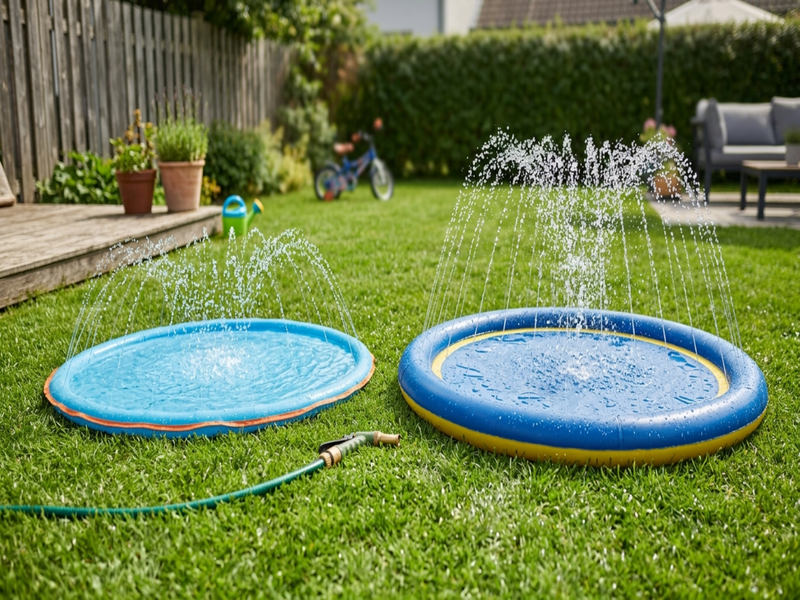
Two splash pads can look almost identical online. They may have the same diameter, similar graphics, the same garden-hose connection, and nearly identical spray patterns. Once they are placed in a real backyard, however, material differences become easier to notice. One pad may feel light and convenient but show wear sooner around the floor or folds, while another feels heavier and better able to handle repeated running, kneeling, dragging, and outdoor setup.
For frequent backyard use, multiple children, larger splash pads, dogs, or harder ground surfaces, thicker PVC generally provides a better durability margin. A thinner or medium-weight splash pad can still be a practical choice for occasional light use on clean grass. Thickness matters, but seam quality, hose-inlet reinforcement, surface texture, ground preparation, water pressure, and storage habits also influence how long a splash pad remains usable.
Think about two families buying the same 10-foot splash pad. One brings it out five times during summer for a preschooler who mostly sits in the center. The other uses it every weekend with three children and a dog chasing the spray. Both families technically own the same type of product, yet they are asking the PVC to handle completely different levels of stress. That is why choosing between thick and thin should start with how the pad will actually be used.
What Is the Difference Between Thick and Thin Splash Pads?
A thick splash pad uses a heavier PVC sheet that provides more material to tolerate abrasion, stretching, bending, and localized pressure. A thin splash pad generally weighs less, folds more easily, and can cost less to manufacture. Neither option is automatically better. The important difference is whether the material thickness matches the product size, users, ground conditions, and expected frequency of play.
PVC Thickness Basics
When a splash pad specification lists 0.30 mm, 0.40 mm, 0.50 mm, or 0.55 mm PVC, the figure normally refers to the nominal thickness of the flexible PVC sheet before the finished pad is assembled and welded. It should not be confused with the height of the outer spray ring, the depth of water collected in the center, or the spray height produced after the garden hose is connected.
Although the numbers look very small, their relative differences are meaningful. A 0.50 mm sheet contains substantially more material through its wall than a 0.30 mm sheet. When materials with similar formulations are compared, that extra thickness gives scratches, abrasion, or pointed objects more material to pass through before a complete leak develops.
Thickness should still be viewed as part of a complete structure. A 0.50 mm floor with inconsistent welding can perform worse than a carefully constructed 0.40 mm pad with a strong perimeter seam, well-supported inlet, and appropriate surface texture. Material gauge tells you how much PVC is present; it does not tell you how well the entire product was engineered.
| Nominal PVC Thickness | Practical Description | Typical Use Pattern | Main Trade-Off |
|---|---|---|---|
| 0.25–0.30 mm | Light | Occasional, low-intensity play | Easy handling, less material reserve |
| 0.35–0.40 mm | Medium | Regular family backyard use | Balanced weight and durability |
| 0.45–0.50 mm | Thick | Frequent use, several children, some pet use | More wear resistance, greater weight |
| Around 0.55 mm | Heavy range | Larger or more demanding designs | More material, stiffness, and storage bulk |
These are practical comparison ranges rather than official industry grades. PVC formulation, welding method, surface embossing, printing, product geometry, and production consistency can all affect how two splash pads with the same nominal gauge perform.
What “Thickened PVC” Really Means
Words such as “thickened,” “premium,” “upgraded,” and “heavy duty” are common in recreational PVC products, but they are difficult to compare unless an actual thickness is provided. One seller may call 0.35 mm material heavy duty, while another may use 0.50 mm without putting a promotional label on it. The measurable specification is therefore more useful than the adjective.
Even an exact millimeter value should not be treated as a complete quality score. A useful product description should also explain the intended users, pad dimensions, surface construction, hose connection, recommended setup conditions, and other structural details. Those specifications allow families to judge whether the product matches the way they intend to use it.
During splash pad development, EPN evaluates material thickness together with pad size, structure, welding behavior, intended users, and outdoor-use conditions. Different products do not automatically receive the same PVC gauge simply because they belong to the same category. A compact children’s pad and a larger model intended for frequent family or pet use create different demands on the material.

How Much Does 0.1 mm Matter?
A difference of 0.1 mm sounds tiny until it is compared with the starting thickness. Moving from 0.30 mm to 0.40 mm represents roughly a 33% increase in nominal sheet thickness. Moving from 0.40 mm to 0.50 mm represents a 25% increase. Those percentages do not translate directly into an equal increase in lifespan, but they show that the material change is more substantial than the small decimal numbers suggest.
Extra thickness becomes particularly useful when pressure is concentrated. A child’s bare foot spreads weight over a relatively broad area, while a small stone, dog nail, toy corner, or rough spot underneath the pad can focus force into a very small point. Additional PVC gives that stress more material to travel through before it reaches the opposite surface.
Large splash pads deserve even more attention because they contain more total floor area, more folded material, and a longer outer seam. As size and user count increase, material thickness becomes more valuable, but so does consistent welding and good structural design.
Thick and Thin Feel Different
Thin PVC normally feels lighter and softer when handled. It can be easier to unfold, shake dry, fold into a smaller package, and carry between storage and the backyard. Those advantages are meaningful for people who use a splash pad only occasionally, travel with it, or have limited storage space.
Thicker PVC tends to feel more substantial and can provide additional resistance when children kneel, run, or move across the floor. The trade-off appears after the water is turned off. A large pad made from heavier material takes more effort to lift, dry, fold, and store than a lightweight version of similar dimensions.
For this reason, the best comparison is not simply “strong versus weak.” It is a balance between durability margin and everyday convenience. Families should buy enough material for their realistic use pattern rather than choosing the highest number available without considering size, handling, and storage.
How Does Thickness Affect Splash Pad Durability?
PVC thickness affects how much material is available to absorb surface wear, small punctures, bending, and repeated handling. Thicker PVC generally offers greater resistance under similar conditions, especially during frequent use. It cannot, however, compensate for sharp debris under the pad, poor welding, weak fittings, repeated dragging across concrete, extreme folding, or other stresses created by setup and handling.
Punctures and Sharp Points
A puncture develops when force is concentrated strongly enough to pass through the PVC wall. Small stones hidden beneath the floor, dry sticks in grass, hard-edged toys, pet nails, and rough patio debris are common examples. A thicker sheet increases the depth an object must penetrate before a complete hole forms, providing a useful margin when all other conditions are similar.
That extra protection does not make a splash pad puncture-proof. A sharp object can still damage relatively heavy flexible PVC when enough pressure is applied. This is particularly relevant for dogs because nails transfer body weight through much smaller contact areas than bare feet. Quick turns, jumping, or pushing off against a wet floor can also introduce horizontal scratching forces.
Good setup remains one of the best forms of protection. Removing stones and sticks, checking the full footprint of the pad, keeping pet nails reasonably trimmed, and avoiding hard-edged toys can prevent damage before thickness ever becomes the deciding factor.
Abrasion and Bottom Wear
Abrasion differs from a puncture because it develops gradually. When children run, kneel, and shift their weight, the splash pad may move slightly against the surface beneath it. Each movement can create a small amount of friction, especially when the material is wet and loaded with water.
Clean grass is generally more forgiving than concrete, rough stone, or textured decking. A lawn can still hide small stones, exposed roots, sprinkler fittings, or compacted soil, but the underlying surface typically provides more cushioning. On a hard patio, repeated sliding against fine texture can wear the bottom much more quickly.
Thicker PVC provides more material before that surface wear becomes a through-hole. Even so, a heavy pad should never be dragged across abrasive ground while it still contains water. Ground preparation and careful handling can sometimes have a greater effect on product life than adding another fraction of a millimeter of PVC.
| Stress Type | Common Cause | How Thickness Helps | What Still Matters |
|---|---|---|---|
| Point puncture | Pebble, dog nail, toy edge | Adds penetration margin | Remove sharp objects |
| Bottom abrasion | Concrete, stone, rough deck | Adds material before wear-through | Protect the setup surface |
| Stretching | Running, kneeling, edge loading | Adds structural reserve | Product geometry |
| Fold stress | Repeated storage cycles | Adds material at crease areas | Avoid severe repeated folds |
| Seam separation | Pressure or weak welding | Limited direct benefit | Seam design and welding quality |
| Inlet damage | Hose twisting and pulling | Supports surrounding sheet | Connector reinforcement |
A thicker pad placed carelessly on rough concrete can therefore wear faster than a medium-weight pad used carefully on clean grass. Thickness improves durability potential, but the environment determines how quickly that potential is consumed.

Seam Strength
The outer seam is one of the most important structural areas in a splash pad. The perimeter must contain flowing water while being stepped on, folded, stretched, and occasionally pulled sideways. These combined loads make seam quality just as important as the PVC gauge used in the body.
A thicker sheet does not automatically produce a stronger weld. High-frequency welding depends on several factors, including material formulation, bonded width, pressure, dwell time, tooling, surface cleanliness, and production control. If the bonded area is too narrow or inconsistent, increasing sheet thickness alone may not correct the weakness.
This is why experienced PVC manufacturing teams test the finished structure rather than judging material by feel alone. A carefully welded 0.45 mm product may be more dependable than a heavier 0.55 mm model with poorly controlled perimeter construction. Shoppers cannot see every manufacturing parameter, but they can look for clean, even seams and avoid treating thickness as the only sign of durability.
Folding and Seasonal Wear
A splash pad experiences stress during storage as well as during play. Each season may include dozens of cycles of unfolding, filling, drying, folding, and packing. Repeated sharp folds can concentrate bending in the same places, especially when the product is stored tightly compressed for months.
Thicker material gives the crease more PVC to work with, but heavier material can also develop more pronounced fold memory if it is repeatedly packed along the same lines. The best approach is to let the pad dry completely, remove sand or grit, and fold it loosely without forcing extremely sharp corners.
Storage conditions matter as well. Flexible PVC should not be left wet inside a sealed container, and heavy items should not be placed on top of tightly folded material for long periods when avoidable. Good seasonal care benefits both thin and thick splash pads and can reduce problems that have little to do with the original material gauge.
Which Splash Pad Thickness Fits Your Use?
The appropriate splash pad thickness depends on the level of stress the product will experience. One toddler playing occasionally on clean grass needs less material reserve than several children using a large pad every weekend. Dogs, harder surfaces, large diameters, frequent setup, and repeated seasonal use all increase the value of thicker PVC, stronger seams, and better-supported connection points.
Toddlers and Light Use
For one toddler using a splash pad a handful of times during summer, maximum thickness is rarely the most important consideration. Surface grip, manageable spray height, comfortable dimensions, drainage, clear setup instructions, and easy storage may have a larger effect on the experience.
A well-made product around 0.35–0.40 mm can be a sensible reference point for moderate, controlled use on clean grass. The seam, floor texture, and hose inlet should still be evaluated because PVC gauge cannot compensate for weak construction.
Parents should also consider how the product will be used in the future. A pad purchased for one three-year-old may soon be shared with an older sibling, neighborhood friend, or visiting cousin. Choosing a little more material reserve can make sense when the household expects the intensity of use to increase.
Multiple Children
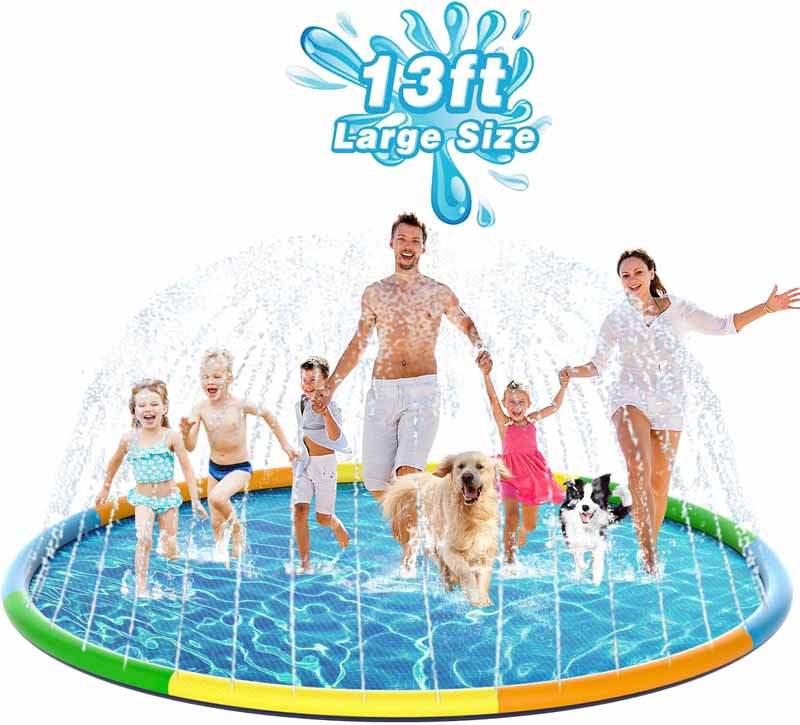
Several children create more than additional static weight. They run in different directions, sit on the outer ring, carry toys, kneel, jump, and create repeated loading cycles across the floor. A large pad can experience hundreds of individual pressure changes during a single afternoon.
For regular multi-child use, 0.40–0.50 mm PVC is a useful comparison range, particularly as the overall diameter increases. Larger models have more surface area contacting the ground and a longer perimeter that must remain consistently welded.
| Use Pattern | Practical Reference Range | Preferred Setup | Main Quality Priority |
|---|---|---|---|
| One toddler, occasional use | 0.35–0.40 mm | Clean grass | Grip and easy handling |
| Two children, regular use | 0.40–0.45 mm | Grass or protected patio | Seam consistency |
| Three or more children | 0.45–0.50 mm | Level prepared surface | Perimeter and inlet strength |
| Children plus dog | 0.45–0.55 mm | Grass preferred | Thickness, grip, nail management |
| Frequent weekly use | 0.45–0.55 mm | Well-prepared ground | Balanced overall construction |
These ranges are practical selection references, not formal pass-or-fail standards. PVC formulation, size, structural design, welding quality, and intended market can justify different specifications.

Dogs and Shared Play
Dogs place a different type of stress on flexible PVC because their weight is transferred through relatively small paw areas. When a dog turns, accelerates, or tries to regain traction, its nails may momentarily focus significant force on a few points.
For shared child-and-pet use, material around 0.45–0.55 mm can provide more useful reserve than lightweight PVC. Floor texture is equally important because better wet traction can reduce the tendency for a dog to dig its nails into the surface when turning.
Owners should still keep nails trimmed and discourage scratching, chewing, and digging. Even relatively heavy PVC remains a flexible recreation material rather than an indestructible floor. A calm 8 kg dog walking through shallow water creates very different loads from a 35 kg dog sprinting after moving water jets.
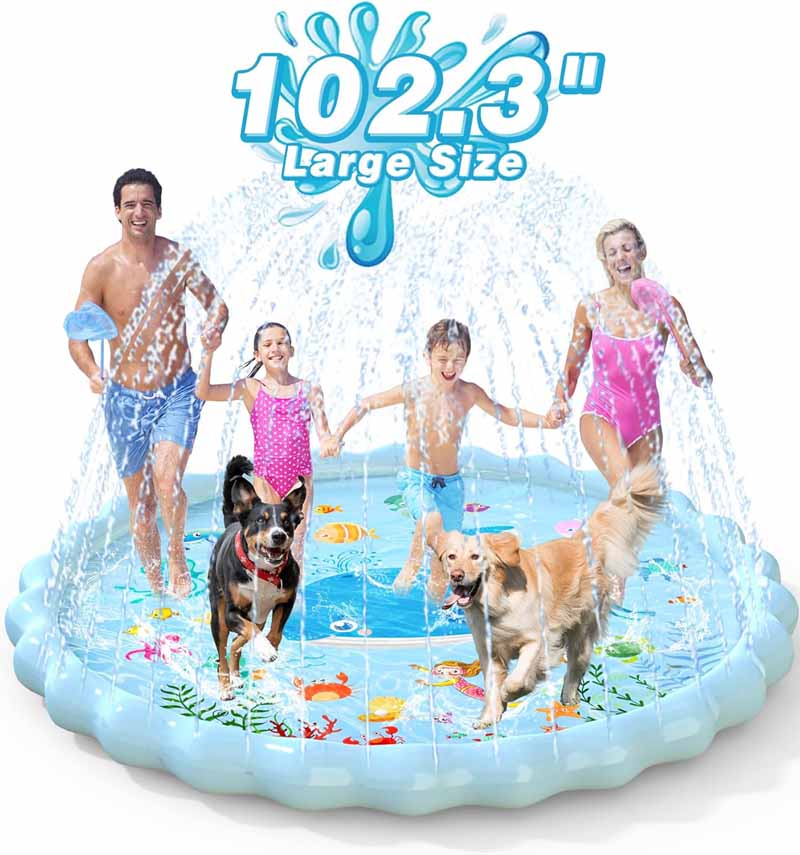
A product genuinely intended for mixed family and pet use should therefore be designed around the expected movement pattern, not simply marketed with pictures of both children and dogs.
Grass, Patio, and Concrete
Ground type can significantly change the durability requirement even when the same users are involved. Clean grass is usually the preferred surface because soil and vegetation provide some cushioning, but the area should still be checked for stones, roots, irrigation fittings, sticks, and other objects hidden below the blades.
Concrete and textured patios require more caution. Fine surface roughness can abrade PVC gradually, while grout lines, decking hardware, stone joints, and trapped particles can create local pressure points. The risk becomes greater when a water-filled pad slides even slightly across the surface.
For regular hard-surface use, thicker material can be worthwhile, but a smooth protective ground sheet may be just as important. The protective layer should lie flat and remain free from sharp folds or debris. Material selection and ground preparation work best together rather than being treated as substitutes for one another.
Is a Thicker Splash Pad Always Better?
No. Thicker PVC generally increases durability margin, but it also adds weight, folded volume, stiffness, material cost, and handling effort. The best splash pad is not necessarily the one with the highest material gauge. Good products balance PVC thickness with seam strength, wet-surface grip, inlet reinforcement, spray performance, flexibility, portability, and the needs of the people or pets using them.
Flexibility and Handling
Flexible PVC has to perform two opposite jobs. During play, it needs enough body to resist abrasion, movement, and localized pressure. After play, it must be flexible enough to drain, dry, fold, carry, and store without becoming frustrating to manage.
Increasing thickness changes that balance. A small material sample may not feel dramatically heavier, but a large splash pad contains several square meters of PVC. An increase in gauge across that entire area can add noticeable mass and make a large pad more cumbersome once it is wet.
Families with small storage areas, frequent travel plans, or only occasional summer use may therefore prefer a well-made medium-weight pad over the heaviest available model. Durability only adds value when the product remains practical enough to use regularly.
The engineering goal is not maximum material. It is enough material for expected stress without unnecessary bulk.
Seams and Edge Design
A splash pad is more than a sheet of PVC. Its outer edge forms a water-carrying structure that must hold pressure and maintain a controlled spray pattern. That edge also experiences bending, stepping, folding, and local stress near structural transitions.
When failures occur along a seam, simply increasing material thickness everywhere may do very little. The better solution may be a wider welded area, improved tooling, revised geometry, more consistent production settings, or reinforcement around the affected location.
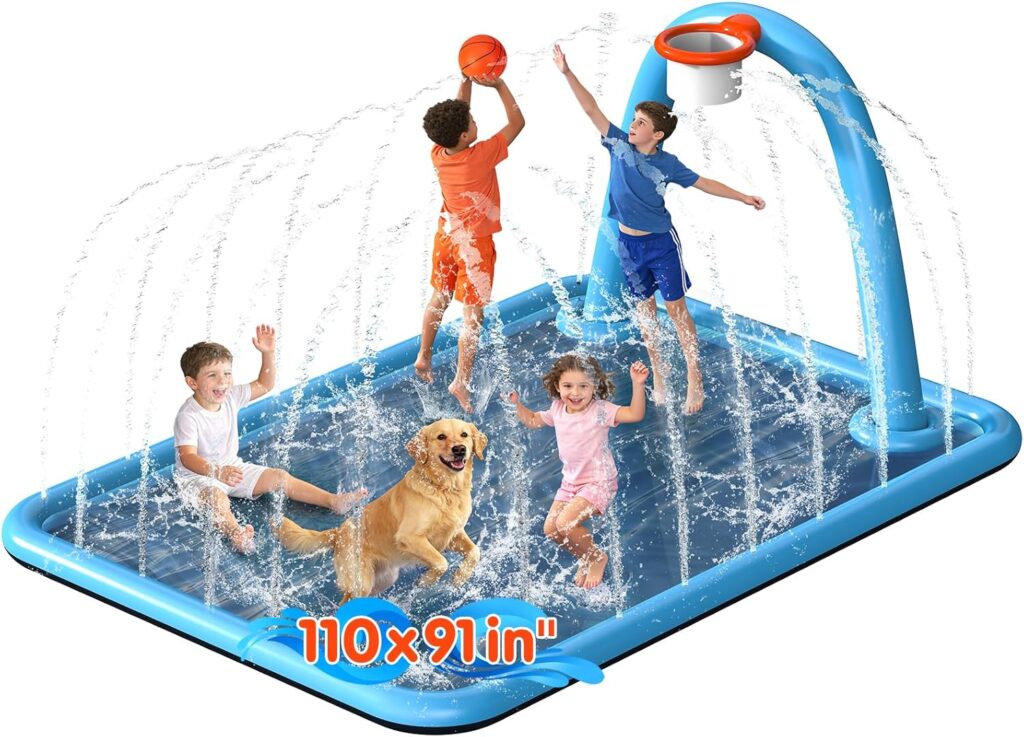
Shape can influence this as well. Circular splash pads distribute forces differently from rectangular, goal-style, or more complex designs. Products with additional structures or abrupt transitions may require different material and welding decisions even when their overall dimensions are similar.
This is why reliable PVC development starts with the actual failure mode. Material should be increased when material reserve is the problem; structural details should be changed when the structure is the problem.

Hose Inlet Strength
The hose connection occupies only a small portion of a splash pad, but it can experience some of the most concentrated mechanical stress. The fitting must remain sealed while water is flowing and tolerate repeated installation, removal, twisting, and occasional pulling.
A connected garden hose can act like a lever. If the pad is moved after connection or the hose becomes tight, force is transferred into the surrounding PVC. Thicker material provides additional support, but reinforcement and geometry around the fitting are equally important.
Users can protect the inlet by positioning the pad before connecting the hose and leaving enough hose slack to prevent sideways pulling. The product should never be moved by pulling the connector or dragging it through the hose.
When comparing two products with similar PVC thickness, a better-supported inlet can be a more meaningful durability advantage than a small difference in sheet gauge.
Surface Grip and Water Control
Material thickness and slip resistance solve different problems. A heavy, smooth PVC surface can still be slippery, while a somewhat thinner sheet with suitable embossing can provide better wet traction. For children and dogs, floor texture deserves attention alongside material gauge.
Water pressure also affects how the product behaves. Increasing household water flow usually raises the perimeter and spray height, but operating at maximum pressure is not necessarily desirable. Excessive flow can place unnecessary load on the outer structure and create spray that is uncomfortable for younger children.
A well-balanced splash pad combines suitable material thickness, consistent welded seams, stable inlet construction, useful wet grip, evenly distributed spray holes, controllable household water flow, and clear setup guidance. None of these features should be expected to carry the entire product by itself.
How Do You Choose the Right Splash Pad Thickness?
Choose thickness according to realistic use rather than automatically selecting the largest number. Consider the number and age of users, dogs, pad dimensions, ground surface, play frequency, portability, and storage. For demanding family use, thicker PVC usually provides better material reserve. For occasional play on clean grass, medium construction may offer a more practical balance between durability, cost, weight, and convenience.
Start With Real Use
Begin with the most demanding situation that is reasonably likely to happen. A family may initially describe the product as being for one child, yet siblings, neighbors, cousins, or the family dog may regularly join once the pad is set up. Selecting for the real household pattern reduces the chance of buying a product that is under-specified from the beginning.
Frequency also changes the calculation. If a splash pad is used twice a week during a 12-week summer, it may experience around 24 complete use cycles. Every cycle involves unfolding, filling, body movement, water pressure, drainage, drying, and storage. A product used only five times in the same season experiences far less cumulative handling.
Size adds another factor. Larger models have more ground-contact area, more perimeter seam, and more room for several users to move independently. As dimensions increase, stronger overall construction becomes increasingly valuable.

Is 0.5 mm PVC Worth It?
For frequent family play, larger pads, several children, or occasional dog use, 0.50 mm PVC can represent a meaningful material upgrade over light 0.25–0.30 mm constructions. More PVC is available to absorb wear, scratches, repeated bending, and localized pressure.
Whether the upgrade is worth paying for depends on how much of that durability will actually be used. A family setting up a large splash pad every weekend has a stronger reason to choose heavier material than someone buying a small pad for four afternoons per year.
The decision should also consider the rest of the structure. Once a sheet becomes stronger, the weakest point may shift to the seam, inlet, or another high-stress area. Increasing thickness without improving the surrounding construction does not guarantee a proportionate improvement in product life.
EPN splash pad products and development projects commonly consider PVC specifications in approximately the 0.40–0.55 mm range, depending on size, structure, intended use, and product requirements. The important point is that the gauge is selected to suit the application rather than applied uniformly to every design.
Verify More Than the Number
An actual thickness specification gives consumers something measurable, but several details should be checked together. The strongest products tend to show consistency across material choice, construction, operation, and care rather than relying on one impressive specification.
| Buying Check | What to Look For | Why It Matters |
|---|---|---|
| PVC gauge | Actual millimeter specification | Makes material easier to compare |
| Pad dimensions | Diameter, length, and width | Larger designs face greater total loading |
| Intended users | Kids, pets, or shared use | Helps match material to expected stress |
| Perimeter seam | Even, continuous welded area | Supports water pressure |
| Hose inlet | Secure, supported construction | Reduces concentrated pulling |
| Floor texture | Wet-grip pattern | Improves footing |
| Ground guidance | Suitable setup surfaces | Reduces abrasion and puncture risk |
| Storage guidance | Drying and folding instructions | Reduces long-term crease damage |
For commercial or private-label sourcing, evaluation can go further by checking production samples, material tolerances, welding consistency, leak performance, pressure behavior, folding resistance, and other product-specific tests. These checks provide much more useful information than requesting “the thickest PVC” without explaining how the product is intended to be used.
Choose Overall Value
The right purchase balances material strength with convenience and expected service conditions. Light PVC may be completely adequate for occasional low-intensity use. Medium construction suits many typical households. Thicker 0.45–0.55 mm-class material becomes increasingly useful as pad size, user count, pet activity, play frequency, and surface demands increase.
Price alone can therefore be misleading. A cheaper product is poor value if it is badly matched to the environment and wears out quickly. The thickest product can also be poor value if its added weight and material are unnecessary for the way a family actually plays.
A practical buying decision starts with who will use the splash pad, how often it will come out, where it will be placed, and whether pets will join. Material thickness should then be compared alongside seams, inlet design, floor grip, product size, and storage needs. That sequence makes it much easier to distinguish real durability from a simple “heavy duty” claim.
Conclusion
A thick splash pad usually makes more sense for families who expect frequent use, several children, larger dimensions, dogs, or demanding outdoor surfaces. Extra PVC provides more physical material to tolerate abrasion, small punctures, folding, and repeated movement, and that additional reserve becomes increasingly valuable as the intensity of use rises.
Thickness is still only one part of a reliable splash pad. Strong seams, a properly supported hose inlet, appropriate wet-surface texture, controlled water flow, careful ground preparation, thorough drying, and sensible storage all contribute to how long the product remains usable. A heavy sheet with weak construction can fail sooner than a lighter but better-designed product.
The most useful question is therefore not “Which splash pad is the thickest?” but “Which construction fits the way my family will actually use it?” Once user count, pets, surface type, frequency, pad size, and storage requirements are clear, the material choice becomes much easier. The best splash pad is the one that combines enough PVC with sound construction and practical everyday handling.
Frequently Asked Questions
Is a thicker splash pad better than a thin one?
A thicker splash pad generally offers more material to tolerate abrasion, small punctures, repeated folding, and active play, making it especially useful for frequent use, several children, or pets. A thinner pad can still be practical for occasional use on clean grass. The final quality also depends on seams, the hose inlet, surface texture, ground conditions, and how the pad is stored.
Is 0.5 mm PVC thick enough for a splash pad?
For many family splash pads, 0.50 mm PVC is a substantial material specification and can provide a useful durability margin for regular backyard use, multiple children, or occasional pet play. It should still be evaluated with product size, PVC formulation, welding quality, floor texture, and inlet design because the material gauge alone cannot guarantee overall durability.
What thickness splash pad is best for dogs?
For shared dog and family use, PVC around 0.45–0.55 mm can provide more material reserve than very light constructions. Dog size, nail length, movement, and surface grip also matter. A larger active dog creates greater localized stress, so owners should keep nails reasonably trimmed, prevent digging, and place the pad on a clean, forgiving surface whenever possible.
Can a thick splash pad still get punctured?
Yes. Thicker PVC increases the amount of material a sharp object must penetrate, but no flexible splash pad is completely puncture-proof. Stones, sticks, hard toy edges, dog nails, and rough concrete can still cause damage under enough pressure. Inspecting the ground and avoiding dragging a water-filled pad remain important even when the product uses heavier PVC.
Is a thicker splash pad harder to fold and store?
Usually. Increasing material thickness adds weight and folded volume, especially on large splash pads. Heavier PVC remains flexible but may require more effort to dry, fold, and carry. For long-term storage, let the pad dry fully and use loose folds instead of compressing it into the same sharp crease lines every season.
Does PVC thickness matter more than seam quality?
Neither should be judged alone. PVC thickness mainly affects resistance to surface wear, punctures, bending, and localized stress, while seam quality affects how well the water-carrying perimeter remains bonded under pressure and movement. A thick pad with poorly controlled welding can fail prematurely, while a somewhat lighter product with strong, consistent seams may perform more reliably.
What should I check besides splash pad thickness?
Check the welded perimeter, hose-inlet support, floor texture, overall dimensions, intended users, recommended ground type, spray control, drainage, repair options, and storage instructions. These details reveal whether the product was designed as a complete outdoor system. Thickness is useful for comparing material strength, but reliable splash pads combine an appropriate gauge with sound construction and proper use.