Skip to content

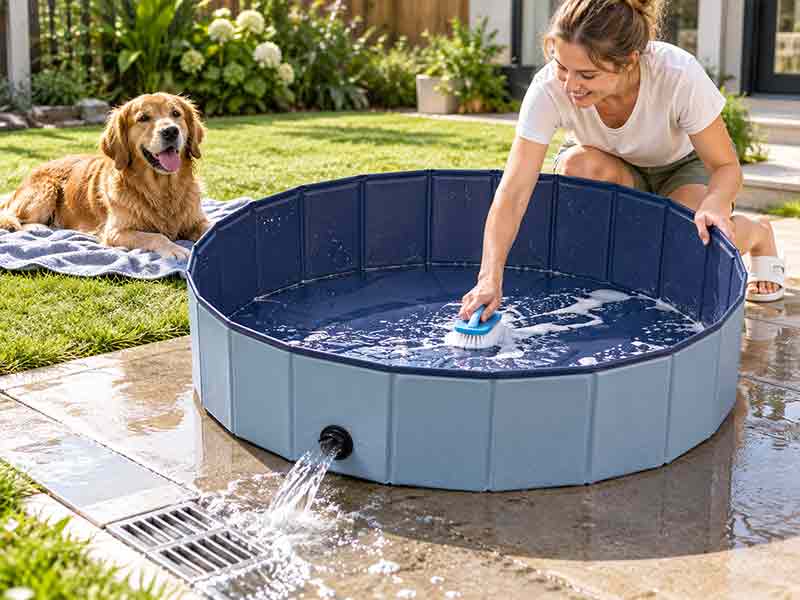
A drain plug is easy to overlook when choosing a dog pool. Most people naturally pay more attention to diameter, wall height, foldability, colors, and whether the floor looks comfortable for wet paws. The drain usually becomes important later, when playtime is over and the pool is holding a mixture of water, loose hair, grass, mud, and fine sediment. At that moment, a small fitting near the bottom of the wall can determine whether cleanup is straightforward or whether the owner has to lift, tilt, squeeze, and repeatedly rinse the pool.
A well-designed dog pool drain plug gives water a controlled path out of the pool while reducing lifting, residual water, messy runoff, and cleaning effort. Its performance depends on outlet height, internal flow area, sealing, accessibility, floor shape, and hose compatibility. These details become increasingly important as pool diameter and water volume increase.
Water weight explains why this feature matters more than its size suggests. The U.S. Geological Survey lists water at about 8.33 pounds per U.S. gallon, so even 50 gallons represents more than 400 pounds of water. A medium or large dog pool can therefore become far too heavy to handle safely while filled, making controlled gravity drainage the practical way to remove most of the load.
The best drain systems rarely feel impressive in use because they simply do their job. The plug stays sealed while the dog plays, opens without difficulty afterward, lets water leave where intended, and leaves little enough behind that rinsing and drying are manageable. That quiet convenience often determines whether a dog pool feels easy enough to set up regularly throughout warm weather or becomes something the owner avoids because cleanup takes too much effort.
What Does a Dog Pool Drain Plug Do?
A dog pool drain plug creates a controlled exit for water so the pool can be emptied without lifting or overturning a filled structure. Its usefulness depends on more than the presence of a cap. Outlet height, flow area, sealing, floor shape, ground level, and the amount of water remaining after gravity drainage all affect real-world performance.
How Does Gravity Drainage Work?
Most foldable dog pools rely on gravity rather than an electric pump. When the drain is opened, the water surface inside the pool is higher than the outlet, so water moves toward the lower discharge point. Flow is generally strongest when the pool is relatively full because there is more water above the opening. As the level falls and the available water pressure decreases, drainage naturally becomes slower.
The amount of weight involved can be surprisingly large. Water weighs approximately 8.33 pounds per U.S. gallon, or close to one kilogram per liter. A pool holding 50 gallons therefore contains roughly 417 pounds of water, while 100 gallons is more than 830 pounds. Those figures make it clear why owners should remove most of the water while the pool remains supported on the ground rather than treating it like a bucket that can simply be picked up.
The estimates below use simple cylindrical dimensions to illustrate scale. They are not rated capacities for specific products because real dog pools may have flexible walls, tapered shapes, folds, and recommended fill levels below the full wall height.
| Approx. Pool Diameter | Example Water Depth | Approx. Water Volume | Approx. Water Weight |
|---|---|---|---|
| 36 in | 8 in | 35 gal | 292 lb |
| 48 in | 10 in | 78 gal | 650 lb |
| 55 in | 10 in | 103 gal | 858 lb |
| 63 in | 12 in | 162 gal | 1,349 lb |
These numbers also show why drain performance matters more as pool size increases. A valve does not need to remove every drop on its own, but it should reduce the water to a shallow, manageable amount before the owner needs to move or wipe the product. That is the point at which the drain stops being a small accessory and becomes part of the pool’s basic usability.
Why Is Drain Placement Important?
Drain position determines how far the water level can fall before gravity drainage stops. If the effective opening sits several inches above the floor, water below that height cannot naturally flow upward into the valve. The owner must then push down a wall, move the remaining water manually, or tilt the nearly empty pool. This is why two products that both advertise a “drain valve” can provide noticeably different cleanup experiences.
A lower outlet generally reduces residual water, but the lowest possible location is not automatically the best engineering solution. The lower wall and floor connection is an important structural area in many foldable PVC or composite pools. A rigid fitting placed through a heavily stressed bend, seam, or folding line may introduce unnecessary stress during filling, dragging, folding, or storage.
Outside clearance also matters. A valve placed extremely close to the ground may be difficult to open when the pool is sitting on grass, a rubber mat, or a patio surface. The cap may collect soil, and a hose adapter may be awkward to connect. A practical design therefore places the effective internal flow point as low as possible while maintaining sufficient material support and room for normal operation.
Consumers can judge this better from an interior product photo than from an exterior view. The useful question is not how low the cap looks from outside, but how close the actual water opening sits to the lowest usable area of the pool floor.
Does Pool Size Affect Drainage Needs?
Pool size changes drainage requirements significantly because increasing diameter and water depth increases both total water weight and the amount of floor area where dirt and hair can settle. A small bathing tub may leave a little water that can be guided toward the outlet without much effort. A 48-, 55-, or 63-inch pool used by medium or large dogs creates a much bigger maintenance task.
Larger pools also expose the limitations of narrow flow paths. A small outlet can still work correctly, but it may take considerably longer to handle a large volume of water. That does not mean the solution is simply to install the largest possible valve, because larger rigid fittings take up more wall area, may require more reinforcement, and can become awkward protrusions on products designed to fold compactly.
A balanced system for a larger pool usually combines three characteristics: a reasonably low outlet, sufficient internal flow area, and a controlled-drainage option when the location requires one. Fast direct drainage is useful when water can safely spread into the surrounding area, while hose-controlled drainage is useful when runoff has to be moved away from a patio, landscaped area, doorway, or heavily used part of the yard.
Manufacturers should therefore evaluate drainage at each pool size rather than assume one valve will perform equally well across an entire range. A fitting that is perfectly adequate on a small pool may feel slow or leave proportionally more troublesome residual water on a much larger model.

What Happens Without a Good Drain?
When the drain does not remove enough water, owners usually compensate by manipulating the pool. They may push one wall downward, raise the opposite side, squeeze the flexible floor, or pour water over the edge. These methods can work after most of the load is gone, but they are inconvenient when several gallons remain because the outlet sits too high or the pool floor directs water away from it.
The remaining water is also rarely clean. After dogs have been playing, it may contain fur, mud, sand, grass, saliva, and fine outdoor debris. Tilting a pool can send that mixture over a wide area instead of through one controlled point, potentially creating muddy ground while also redistributing dirt across the floor. That means the owner may still need another rinse before the product is ready to dry.
Repeatedly bending a flexible pool while it still contains significant water can also put unnecessary load on wall panels and seams. A good drain reduces that handling by removing the bulk of the weight first, keeping the pool stable until only a shallow amount of rinse water remains.
The practical difference is easy to understand: one product finishes playtime with drain, rinse, and dry; another finishes with drain, push, lift, rinse, tip, wipe, and finally dry. Over an entire season, that difference can matter more than many highly visible product features.
How Does Drain Design Affect Cleaning?
Drain design affects cleaning because dirty water has to leave before the walls and floor can be rinsed efficiently. A low, accessible outlet helps move hair, mud, grass, and rinse water out of the pool. A high, narrow, or easily blocked outlet leaves more material behind and can turn routine cleanup into repeated lifting and repositioning.
How Do Hair, Mud, and Debris Affect Draining?
Dog-pool water is very different from the clean tap water normally used for a simple drainage demonstration. Dogs carry loose hair, soil, sand, grass, and small leaves on their coat and paws. Some fine particles remain suspended while the dog is moving, while heavier dirt eventually settles to the bottom. Once the valve opens, much of that material begins moving toward the same outlet as the water.
Hair is particularly difficult because strands can catch on internal edges, ribs, threads, and adapter transitions. A few strands may not noticeably change the flow, but they can form a loose mat that traps additional grass and debris. The result is often a drain that still works but gradually becomes much slower than it was when first opened.
A hose connection can add another restriction. If the inside diameter of the hose or adapter is smaller than the main valve, that narrower section becomes the practical limit on flow. A kinked garden hose can reduce it further, which is why slow drainage should not automatically be blamed on the pool valve itself.
Owners can prevent many of these problems by removing large leaves and obvious clumps of hair before opening the drain. Once the water level drops, the area around the outlet can be checked again. From a design standpoint, a smooth and relatively direct flow path usually performs better in pet use than an unnecessarily complicated internal structure with several narrow steps where fur can collect.
Does Complete Drainage Make Cleaning Easier?
The closer a dog pool gets to practically empty through gravity alone, the easier the cleaning stage becomes. Perfect removal of every drop is not a realistic requirement for a flexible outdoor pool because texture, folding lines, small ground irregularities, and panel seams can create shallow pockets. A more useful target is to minimize standing water so the remaining amount can be managed without lifting the structure.
When only a thin layer remains, the owner can rinse the side walls and floor while directing the new water toward the outlet. Dirt is easier to see, and sediment that has already settled is less likely to be stirred back into several inches of dirty water. When the drain leaves a deeper layer, every movement of the pool can redistribute hair and soil that was already close to being removed.
A practical cleaning routine is simple:
- Drain the main volume of water.
- Remove visible fur, leaves, and larger debris.
- Rinse the walls and floor with clean water.
- Keep the outlet open while rinse water leaves.
- Wipe stubborn dirty areas if necessary.
- Allow the product to dry before folding or storing.
This sequence shows why the drain is part of the cleaning system rather than something used only once at the beginning. A valve that works well when the pool is full but becomes ineffective during the final rinse solves only half of the maintenance problem.

How Does Better Drainage Help With Drying and Storage?
Drying begins with removing as much free water as practical. A pool that still contains standing water takes longer to dry and is more difficult to fold cleanly. On collapsible pools, moisture can remain between folded panels or along seams when the product is packed too soon. Even when this does not damage the material, it can create odors and make the next setup less pleasant.
A low drain reduces the amount of water that needs to be removed with a towel or left to evaporate. After the main volume is gone, the pool can be rinsed, allowed to drain again, and then left open in a ventilated area until the interior surfaces are dry enough for storage.
The surface underneath the pool matters as well. A level, reasonably firm area helps water move toward the intended outlet. If the pool is placed on uneven ground with the opposite side lower than the valve, residual water may remain even when the drain itself has been designed correctly.
This is a useful reminder that drainage performance is created by more than one part. Valve position, floor flatness, panel stiffness, surface texture, folding pattern, and setup conditions all influence the final result. Good product design makes these features work together so that cleanup does not require the owner to understand the engineering behind them.
Does the Pool Surface Matter?
The floor surface affects both paw traction and drainage. A textured interior can help wet paws maintain better contact, but very deep grooves may also retain fine sediment and small amounts of water. A completely smooth floor is easier to wipe but may not provide the same level of grip. The goal is therefore a practical balance rather than maximizing either smoothness or texture.
Floor shape matters just as much. Flexible bases can develop small wrinkles or low spots, especially on uneven ground. These areas may hold water even when the outlet is close to the nominal floor level. That is one reason drainage testing should not be limited to a perfectly stretched sample on an ideal laboratory surface.
A useful real-world evaluation places the pool on a firm, level surface, fills it to a realistic depth, allows the walls and floor to settle naturally, and then observes where water remains after gravity drainage. The last part of the process can reveal more than the first because nearly every drain looks effective when a full pool initially sends out a strong stream.
Owners usually remember the final stage instead. If they still have to spend several minutes chasing muddy rinse water across the floor after the main stream stops, the drainage system has not fully solved the maintenance problem.
Which Drain Plug Features Matter Most?
The most useful drain systems combine a low effective outlet, adequate internal flow area, reliable sealing, easy access, and controlled discharge. Hose compatibility adds value when water needs to be directed away from the pool, while well-designed threads, gaskets, and protected fittings reduce leakage and physical damage. The complete system matters more than any one advertised feature.
Is a Low-Position Drain Valve Better?
In most dog-pool applications, a lower effective outlet is preferable because gravity can remove more water before the internal water level falls below the opening. The important measurement is the height of the actual inside flow path, not merely the location of the external cap. A fitting can appear low from outside while still leaving a noticeable layer of water inside.
However, placing the valve as low as physically possible can create problems if the design ignores structure and accessibility. The lower wall is an area where water pressure, folding, and handling loads come together. A rigid fitting needs enough supporting material around it, and its location should not interfere with a critical seam or folding line.
The external part of the fitting also needs clearance from the ground. If the cap sits against grass or paving, it may be difficult to turn, inspect, or connect to a hose. The best position is therefore low enough to minimize residual water but high enough to remain structurally secure and convenient to operate.
| Drain Feature | Practical Benefit | Potential Problem if Poorly Designed |
|---|---|---|
| Low internal outlet | Leaves less standing water | Higher outlet leaves more water behind |
| Adequate flow path | Reduces drainage time | Narrow bore slows large pools |
| Secure cap | Holds water during use | Poor threads may drip or loosen |
| Gasket or O-ring | Improves sealing | Misaligned seal can leak |
| Hose adapter | Controls discharge direction | Narrow adapter may slow flow |
| Protected placement | Reduces impact and chewing | Exposed fitting can be damaged |
| Replaceable components | Extends useful product life | Minor damage may disable entire pool |
This table also explains why the phrase “includes drain plug” tells the owner very little. Two valves can look similar in a product listing while performing very differently once they are connected to the pool floor, wall structure, hose system, and real drainage conditions.

Do Larger Drain Openings Empty Water Faster?
A larger opening can improve drainage, but only when the rest of the flow path is equally open. A large outside cap may hide a smaller internal bore, while a hose adapter may narrow it further. If the user attaches a long or kinked garden hose, that hose becomes another source of resistance. The visible size of the cap therefore does not tell the whole story.
Water depth also affects flow. A fuller pool usually drains faster at the beginning because more water sits above the outlet. As the level falls, the available pressure decreases and the final stage slows. This is normal behavior and means that a simple drain-diameter specification cannot reliably predict how long a pool will take to empty.
For product development, actual testing is more useful than vague wording such as “fast drain.” A repeatable evaluation can fill the pool to a defined depth on a level surface, open the valve in the same way each time, record the time until gravity flow substantially stops, and then measure or estimate the remaining water.
Two results are particularly useful: drainage time under defined conditions and residual water after gravity drainage. Those measurements describe the user experience far better than the outer diameter of a cap or a marketing photograph showing a strong initial stream.
Is a Hose Connector Worth Having?
A hose connector is useful whenever the owner needs to control where the water goes. Direct drainage usually allows the fastest release, but the water exits next to the pool. On a small lawn, patio, grooming area, or space beside a building, releasing dozens of gallons in one location may create temporary pooling or muddy ground.
A hose lets the owner route the discharge toward a more suitable area. The trade-off is usually slower drainage because the hose adds length, friction, and often a smaller internal diameter than the main outlet. That is why a system offering both direct and hose-controlled drainage can be more versatile than one that depends entirely on a narrow hose connection.
Direct discharge makes sense when water can safely spread near the pool and speed is the priority. Hose-controlled drainage is more useful when the owner needs to move the water several feet away or release it in a more controlled location.
The quality of the adapter matters as well. It should be simple to attach, large enough to avoid unnecessary restriction, and easy to store so it does not get lost between seasons. A complicated proprietary fitting may look sophisticated but offers little benefit if customers struggle to use or replace it.
What Makes a Drain Plug Leak-Resistant?
Leak resistance comes from the entire sealing system rather than from the cap alone. The cap needs to engage correctly with the fitting, the sealing surface should remain clean, and any gasket or O-ring should sit flat without twisting or falling out. The rigid valve body also has to remain securely attached to the flexible wall or floor material.
Common causes of leakage include hair or dirt trapped on the sealing surface, damaged threads, a displaced gasket, incomplete closure, excessive tightening that distorts the seal, and physical damage around the valve base. Owners should normally clean and reseat the fitting rather than using tools to force plastic components tighter unless the manufacturer specifically instructs otherwise.
From a production standpoint, this is a small area where simple testing can prevent a large number of complaints. A filled-water hold test can reveal slow seepage that may not be obvious during a quick inspection, while repeated opening and closing can expose alignment, thread, or gasket problems.
The best outcome is intentionally uneventful. During use, the drain should remain sealed enough that the owner does not think about it. When playtime ends, it should open easily and perform its second job without introducing another maintenance problem.
What Problems Do Dog Pool Drains Have?
Dog-pool drains can leak, clog, drain too slowly, leave excessive residual water, or become damaged during handling and pet use. These issues often result from the interaction between valve design, debris, pool position, and maintenance rather than a single defective part. Accessible fittings, smooth flow paths, secure sealing, and replaceable components make most problems easier to prevent or correct.
Why Do Drain Plugs Leak?
A leaking drain does not necessarily mean the entire pool has failed. The first step is to identify whether the water is passing through the removable cap or around the fixed valve body where it joins the pool. Moisture around the cap may be caused by dirt, hair, misaligned threads, or a gasket that is not sitting correctly.
Leakage around the fitting body suggests a different problem and may involve the valve-to-wall connection or surrounding material. Tightening the cap harder will not correct an issue at that interface. The water level should be lowered enough to inspect the area safely before the fitting is cleaned, reseated, or replaced according to the product instructions.
This distinction is useful for both owners and manufacturers because it separates a serviceable seal problem from a structural attachment issue. For production quality control, the drain deserves specific inspection because it brings rigid and flexible materials together in one water-retaining area.
A durable PVC body paired with an unreliable valve can still create a poor product experience. The drain therefore needs to meet the same basic expectations for consistency and durability as the rest of the pool structure.
How Do Hair and Debris Block a Drain?
A partial blockage often explains a valve that begins draining normally and then slows dramatically. Fur moves toward the outlet with the water and can catch on small internal edges. Grass, leaves, and other material then collect against the hair, gradually reducing the effective flow area without necessarily blocking the drain completely.
The problem is more likely after heavy shedding, repeated outdoor use, or play sessions where dogs frequently move between grass and the pool. Once the water level becomes low enough, the inside of the outlet can be inspected and visible material removed. If a hose is attached, the hose and adapter should also be checked for kinks or blockage.
| Symptom | Likely Cause | Practical Check |
|---|---|---|
| Flow begins strong, then slows | Fur or debris at outlet | Remove visible buildup |
| Flow weak only with hose attached | Hose kink or restriction | Straighten hose and inspect adapter |
| Water remains above drain level | Partial blockage | Check internal opening |
| Water remains below drain level | Floor low spot or outlet height | Guide shallow water toward drain |
| Cap drips when closed | Seal or thread issue | Clean and reseat cap and gasket |
| Water appears around valve body | Fitting-to-wall issue | Inspect attachment before reuse |
Sharp tools should not be pushed into flexible drain components because they can damage seals or surrounding material. Cleaning visible debris once the water level is manageable is normally safer than trying to force a blockage through the fitting.

What If Water Remains After Draining?
Some residual water is normal in a flexible dog pool. A large amount, however, usually indicates a combination of outlet height, floor shape, or ground slope. The first thing to check is whether the pool is sitting level. If the ground slopes away from the valve, the lowest point of the floor may be on the opposite side.
Wrinkles or depressions can create similar pockets. Once the main volume has left, small amounts can often be guided gently toward the drain by adjusting the flexible floor. Owners should avoid aggressively lifting or collapsing a wall while substantial water remains because even a few gallons add meaningful weight.
Residual water is also a useful product-development measurement. Instead of recording only that a valve “works,” a test can examine how much water remains after gravity drainage, where it collects, and whether final rinse water can reach the outlet without major repositioning.
These observations are particularly valuable because they mirror the final part of real cleanup. A drain that removes ninety percent of the water quickly may still frustrate customers if the remaining ten percent is difficult to remove.
Can a Damaged Drain Plug Be Replaced?
Replaceable drain parts can extend the practical life of a dog pool because the main body may still be completely usable when a cap, gasket, or hose adapter becomes lost or damaged. Pet products face additional wear because external fittings can be kicked, stepped on during storage, struck while the pool is moved, or chewed by curious dogs.
Using consistent components across several pool sizes can make replacement easier. Manufacturers and brands can keep a smaller range of spare parts, while customer-service teams can identify compatible caps and seals more reliably. Recording thread dimensions, gasket sizes, adapter types, and component revisions also helps prevent near-matching parts from being supplied later.
The drain location should reduce unnecessary exposure while remaining easy for the owner to reach. A fitting that protrudes too far may invite damage, but one hidden too deeply can be difficult to clean or operate.
A small replacement part may cost very little compared with an entire pool, yet it can determine whether the product continues to hold water. That makes serviceability more important than the physical size of the component suggests.
How Do You Choose a Better Drain System?
Choose a dog-pool drain by evaluating the complete drainage process rather than simply confirming that a plug is included. Outlet height, internal flow area, sealing, access, hose compatibility, structural support, residual water, and replacement options all matter. Larger pools deserve especially careful evaluation because greater water volume magnifies small weaknesses in flow, placement, and maintenance.
What Should Dog Owners Check Before Buying?
Product photos can reveal more about drainage than a short list of features. Look for an image showing the outlet from inside the pool so its height relative to the floor can be judged. If only the outside cap is visible, it is difficult to know how much water may remain after gravity drainage stops.
The intended location also affects which features matter most. A large backyard with good natural drainage may work well with a simple direct outlet. A patio, grooming space, small lawn, or area close to a building may benefit from hose-controlled discharge.
A practical pre-purchase check includes the following points:
- Is the effective internal outlet close to floor level?
- Can the cap be opened without lifting the pool?
- Does the flow path look appropriate for the pool size?
- Can hair and visible debris be removed easily?
- Is a hose connection available when controlled drainage is needed?
- Does the cap use a defined seal, gasket, or O-ring?
- Is the fitting reasonably protected from chewing and impact?
- Can important drain components be replaced if lost or damaged?
Customer reviews are particularly valuable for drainage because many weaknesses appear only after the product has been filled and emptied several times. Repeated reports about high drains, slow flow, leakage, or difficult final cleanup are more useful than a single isolated complaint.

Which Drain Design Works Best for Large Dog Pools?
Large dog pools benefit most from a low effective outlet, adequate internal flow area, reliable sealing, and the ability to control discharge when necessary. Their water volume makes manual emptying impractical, so the drainage system should remove the vast majority of the weight before the owner has to touch or reposition the structure.
An optional hose route can add useful flexibility. Direct drainage handles the main volume quickly where runoff is acceptable, while hose-controlled drainage allows water to be moved away from a patio, doorway, or sensitive lawn area. The value of each option depends on how and where the customer plans to use the pool.
Structural support around the valve becomes more important as dimensions increase. Larger pools carry greater water loads, and the lower wall is already a critical area. A large fitting should not create an unsupported weak point near a floor seam, bend, or frequently folded section.
Testing should therefore be performed on realistic full-size prototypes rather than assuming that a valve proven on a smaller model will behave exactly the same when pool diameter increases. Useful measurements include bulk drainage time, residual water, leakage after repeated cycles, wall behavior around the valve, and ease of operating the cap or hose adapter.
What Should OEM Buyers Specify?
A useful technical specification should describe more than “dog pool with drain plug.” That phrase confirms that a component exists but says almost nothing about performance. A stronger specification defines the outlet position, flow path, sealing method, drainage options, reinforcement, test conditions, residual water, and replacement strategy before the design reaches bulk production.
| Specification Item | Useful Question to Define | Practical Purpose |
|---|---|---|
| Outlet position | How high is the effective opening above the floor? | Influences residual water |
| Internal flow path | What is the narrowest internal diameter? | Influences drainage rate |
| Drainage mode | Direct, hose-controlled, or both? | Defines use flexibility |
| Hose interface | What adapter and connection dimensions are used? | Reduces compatibility problems |
| Seal structure | Threaded cap, gasket, O-ring, or valve seal? | Influences leak resistance |
| Wall reinforcement | How is material supported around the fitting? | Reduces local stress |
| Cycle evaluation | How is repeated opening and closing checked? | Reveals wear or alignment issues |
| Filled-water test | At what depth and duration is sealing evaluated? | Confirms water retention |
| Residual water | How much remains after gravity drainage? | Measures practical usability |
| Spare parts | Can caps, gaskets, and adapters be reordered? | Supports longer product life |
Drain specifications should also be reviewed together with PVC or composite construction, wall-panel layout, fold lines, floor texture, weld placement, and packaging. Treating the valve as a generic accessory after the rest of the pool has been finalized can limit the ability to improve its position or reinforce the surrounding structure.
For custom pet-pool development, EPN can evaluate drainage during sampling alongside these structural factors so that outlet height, sealing, hose compatibility, and reinforcement can be adjusted before the final production configuration is locked. The goal is not to make the drain more complicated, but to make its performance measurable and appropriate for the pool size and intended use.
Are Replaceable Drain Parts Important?
Replaceable drain components are especially valuable on products intended for more than one season. A cap may be lost, a gasket may wear, or an adapter may crack while the walls and floor remain perfectly serviceable. If the small damaged component cannot be replaced, the entire pool may effectively become unusable even though its main structure is still in good condition.
This has practical benefits throughout the product life cycle. Consumers can repair rather than replace a complete pool, retailers may reduce unnecessary full-unit returns, and brands can handle after-sales requests with a clearly identified service part instead of shipping an entire bulky product.
The benefits increase when several pool sizes share a common drain architecture. Standard caps, gaskets, and adapters are easier to stock and document, provided the shared component still meets the structural and flow requirements of each model.
The useful lesson is simple: repairability does not require turning a dog pool into a complex mechanical product. It only requires recognizing that the drain is one of the few small components whose failure can directly stop the pool from holding water.
A drain plug occupies only a small area of a dog pool, but it influences nearly every step after filling. It determines how easily hundreds of pounds of water can leave, where dirty water is released, how much fur and sediment remain, how quickly the pool can be rinsed, and how much work is required before the product is dry enough to store.
For dog owners, the key question is therefore not simply whether a pool has a drain. A more useful question is whether the drainage system suits the size of the pool and the location where it will be used. A low outlet, practical flow path, secure seal, optional hose control, and accessible service parts can remove much of the work that normally happens after playtime.
For product developers and manufacturers, the same principle applies from a structural perspective. Drainage should be considered alongside wall construction, floor shape, folding behavior, and material selection rather than added at the end as a generic accessory. When those details are considered together, a very small component can quietly improve one of the most important parts of the ownership experience: making the pool easy enough to clean, dry, and use again.
Frequently Asked Questions
Do Dog Pools Need a Drain Plug?
A drain plug is not essential on every very small pet tub, but it becomes increasingly useful as water volume increases. Because one U.S. gallon of water weighs about 8.33 pounds, even a modest dog pool can become too heavy to lift safely while filled. A drain lets most of that weight leave while the pool stays supported on the ground, which makes cleaning, rinsing, drying, and storage easier.
Where Should a Dog Pool Drain Plug Be Located?
The effective internal opening should generally sit as close to the lowest practical floor level as the structure allows. A lower opening reduces the depth of water left after gravity drainage stops. The valve still needs enough surrounding material for support and enough outside clearance to operate, so the best location balances low residual water with structural strength, folding behavior, and access.
Can You Connect a Garden Hose to a Dog Pool Drain?
Some dog pools are designed with an adapter that allows a garden hose to be attached to the drain. This is useful when the owner wants to direct water away from a patio, doorway, small lawn, or frequently used area instead of releasing the entire volume beside the pool. Hose drainage is often slower than direct drainage because the hose adds resistance, so having both options can be useful.
How Do You Keep Dog Hair From Clogging a Pool Drain?
Remove large clumps of hair, grass, and leaves before opening the drain whenever possible. As the water level falls, inspect the area around the internal opening and clear visible buildup by hand when it is safe to do so. Avoid using sharp tools inside flexible drain fittings because they can damage sealing surfaces or surrounding material. Smooth internal valve geometry also helps reduce places where fur can collect.
Why Does Water Stay in a Dog Pool After Draining?
Residual water can remain because the outlet sits above floor level, the pool is positioned on sloping ground, or flexible flooring has formed shallow low spots. Once the main water volume is gone, small amounts can often be guided gently toward the drain. If several inches remain on a firm, level surface, the drain position or floor geometry may be limiting how completely the pool can empty through gravity alone.
How Can You Tell if a Dog Pool Drain Plug Is Leaking?
First determine whether the water is coming through the removable cap or around the fixed fitting where it joins the pool wall. Leakage through the cap may result from dirt, damaged threads, incomplete closure, or a poorly seated gasket. Water around the valve body may indicate an attachment problem. Cleaning and inspecting the sealing components helps distinguish a serviceable cap issue from a structural leak.
Are Replacement Dog Pool Drain Plugs Available?
Replacement availability depends on the manufacturer and valve design. Products using standardized or documented components are generally easier to maintain because caps, gaskets, and hose adapters can be replaced without discarding the entire pool. For products intended for repeated seasonal use, checking whether drain components can be replaced is worthwhile because a small damaged fitting can otherwise prevent an otherwise functional pool from holding water.