Skip to content
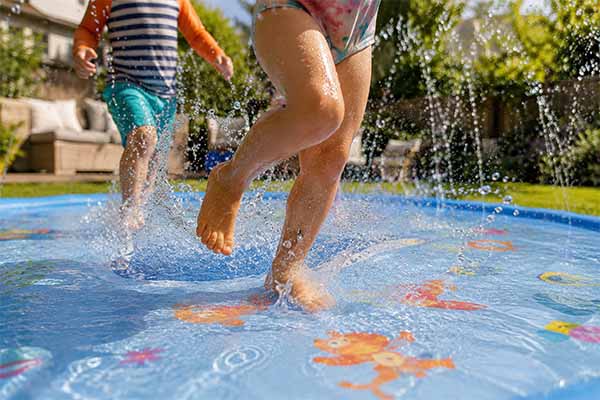
A kids splash pad can look impressive in a product photo and still become frustrating after the first few uses. Bright graphics and tall water streams attract attention, but families usually discover the important details later: whether the wet surface feels stable, whether two children actually have enough room to move, whether spray height can be controlled, whether the hose connection leaks, and whether the whole pad can be drained and stored without taking over the backyard for the rest of the afternoon.
The features that matter most in a kids splash pad are a textured wet-play surface, suitable material and construction, enough usable space for the children using it, adjustable and evenly distributed spray, a reliable hose connection, durable seams and edges, and easy drainage and storage. Decorative themes add fun, but they should come after safety, fit, water performance, durability, and everyday usability.
That difference becomes clearer after a few hot weekends. One family may own an oversized, colorful pad that spends most of summer folded in the garage because setup and drying feel like work. Another family may use a simpler pad several times a week because the children have enough room, the spray behaves predictably, and cleanup is manageable. The best splash pad is not necessarily the one with the longest list of features. It is the one whose important features continue to make sense after the novelty has worn off.
Which Safety Features Matter Most?
The safety features that matter most are a textured wet-play surface, materials appropriate for a children’s product, controllable water flow, a secure hose connection, and a design suited to the child’s age and activity level. No splash pad eliminates the need for supervision, but thoughtful construction can reduce avoidable slipping, crowding, connector movement, excessive spray, and premature material failure.
Surface Grip
A splash pad is designed to become wet while children walk, turn, sit, crawl, kneel, and change direction across its surface. That makes surface texture more important than it may appear on a shopping page. Smooth PVC that feels perfectly normal when dry can become noticeably more slippery after water, sunscreen, grass residue, or dirt is carried onto it by bare feet. An embossed or lightly textured play surface generally provides more useful contact than a highly polished sheet, although no wet recreational surface should ever be described or treated as completely slip-proof.
The location of that texture also matters. A product may advertise a “non-slip design,” yet only have visible texture in a small central area while much of the surface remains smooth. Parents should look at the section children will actually stand and move on, rather than relying on a single marketing phrase. The ground beneath the pad is equally important because flexible PVC follows the surface underneath it. Stones, roots, sprinkler heads, sharp mulch, uneven paving, and sloping soil can create pressure points or unstable areas even when the pad itself is well made.
Before water is turned on, the pad should lie flat and the ground should be checked by hand as well as by sight. This simple habit protects both children and the product. A few minutes spent removing sticks and small stones can reduce puncture risk, while checking for wrinkles and uneven ground helps the pad stay more predictable once the perimeter begins filling with water.
| Safety Detail | What to Check | Practical Benefit |
|---|---|---|
| Wet-play texture | Texture across the main standing area | Improves contact on wet PVC |
| Level ground | Flat placement without obvious slope | Reduces shifting and uneven pooling |
| Clean surface below | No stones, sticks, roots, or sharp debris | Reduces puncture and pressure points |
| Hose position | Hose kept away from normal walking paths | Reduces unnecessary trip hazards |
| Adjustable spray | Water can begin at a low setting | Helps younger children adapt gradually |
| Stable perimeter | Outer water channel fills evenly | Helps keep spray behavior predictable |
Material Safety
“Premium PVC,” “safe material,” and “non-toxic” appear frequently in children’s product listings, but those phrases are not a substitute for specific product information. Flexible PVC can vary in formulation, plasticizer system, thickness, surface finish, printing process, flexibility, and welding performance. Two splash pads can both be made from PVC while feeling and performing very differently after repeated exposure to water, sun, folding, and children stepping on their edges.
For children’s toys sold in the United States, applicable federal requirements can include the mandatory toy safety standard incorporated through 16 CFR Part 1250, as well as requirements addressing lead and regulated phthalates. CPSC states that toys intended primarily for children 12 and under generally require third-party testing and certification for applicable children’s product safety rules. Current limits include 100 ppm total lead in accessible components, 90 ppm lead in paint or similar surface coatings, and 0.1% for each regulated phthalate in covered accessible components.
These requirements do not mean parents need to become laboratory specialists before buying a backyard toy. They do mean that specific compliance information is more meaningful than broad adjectives. When a splash pad is marketed as a children’s toy, the manufacturer or importer should understand which requirements apply to that particular product, intended age group, components, coatings, and destination market.
PVC thickness is useful as an additional construction reference, but it should not be confused with a safety certificate. Many consumer splash-pad structures use flexible films in roughly the 0.40–0.55 mm range, depending on size, structure, folding requirements, intended use, and price position. There is no universal rule that every good splash pad must use one exact thickness. A balanced product combines appropriate material with reliable welding, suitable surface texture, stable water channels, and proper testing for its intended market.
Spray Control
The highest spray is rarely the most useful setting for every child. A toddler may enjoy water reaching only to the knees or waist, while an older child may prefer taller arches that can be run through. A splash pad that allows families to adjust water intensity through ordinary faucet flow gives parents more control without adding complicated valves or moving parts to the product itself.
Most flat PVC sprinkler pads work through a straightforward pressure relationship. Water enters the perimeter channel, fills the ring, and exits through small spray openings. Increasing faucet flow usually raises the spray, while reducing flow lowers it. The best starting point is therefore not “full pressure.” Parents should begin at a modest setting, allow the channel to fill, observe the spray direction, and then increase water gradually until the pattern is comfortable and reasonably even.
If one side sprays much higher than the other, simply increasing pressure can make the problem worse. A twisted edge, partially folded water channel, kinked hose, leaking connector, distorted spray opening, or section that has not filled properly can all create uneven performance. Correcting those conditions often improves the water pattern without increasing consumption or placing unnecessary pressure on the outer ring.

Age Fit and Supervision
Age labels are useful, but they cannot describe every child’s coordination, confidence, sensory preferences, or behavior around water. A cautious three-year-old who prefers sitting near a gentle stream may need a very different setup from an energetic seven-year-old running across the center with siblings. Parents should therefore consider how their children actually play rather than relying only on a number printed on the package.
Mixed-age families need to pay particular attention to available space. Toddlers often move slowly, sit close to the water, and need an adult nearby. Older children take longer steps, change direction quickly, and may turn the splash pad into a running or ball-playing area. Giving the younger child enough separation from faster-moving siblings can matter as much as the product’s overall diameter.
A home splash pad normally contains much less standing water than a traditional pool, but that does not make supervision optional. Wet surfaces, falls, collisions, hoses, and water directed toward the face still require adult attention. Public-health guidance for water play also advises children not to swallow splash-pad water and emphasizes close supervision and good hygiene around recreational water.
How Do You Choose the Right Splash Pad Size?
Choose splash pad size according to usable play space, the number and age of children, and the clear area available in the yard. Advertised diameter is only the starting point because the outer water channel occupies part of the footprint. Children also need room to move, while adults need space for supervision, hose routing, entry, exit, and safe access around the pad.
Usable Play Space
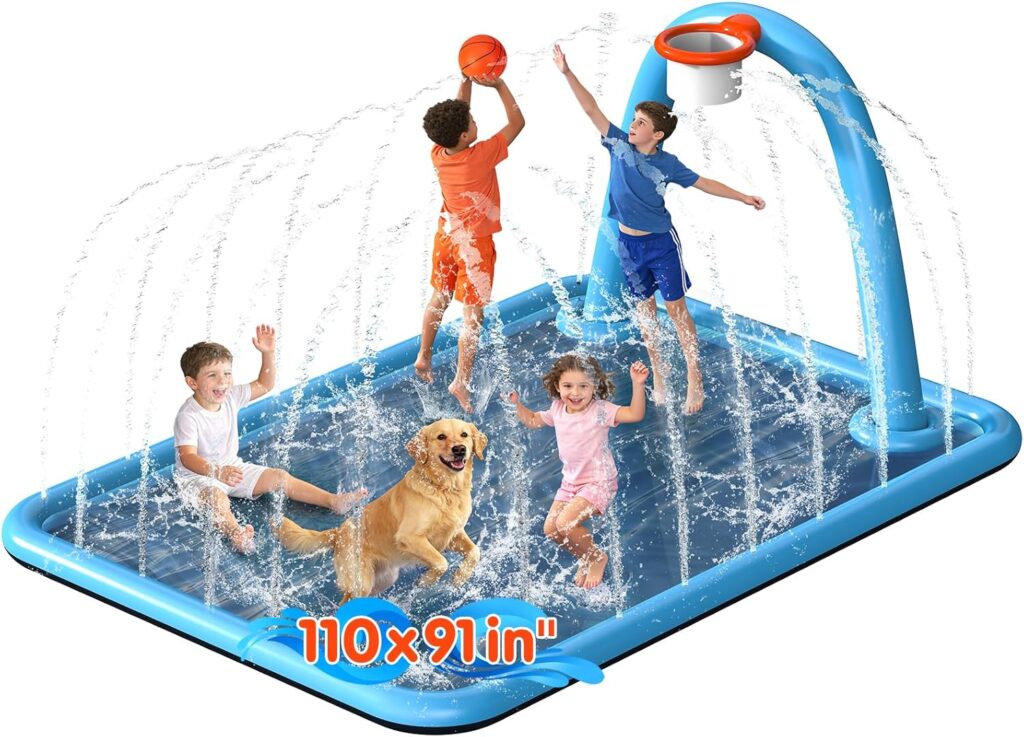
One of the easiest mistakes is treating the advertised size as if every inch were open play space. On a typical sprinkler pad, part of the diameter is occupied by the perimeter water ring. Designs with inflatable arches, goals, fountains, animals, or other three-dimensional structures may reduce the usable center even further. Two products with the same outside diameter can therefore feel surprisingly different once children begin moving around inside them.
Toddlers often use space differently from older children. A younger child may spend long periods sitting, touching individual streams, filling a cup, or staying near one side of the pad. School-age children are more likely to cross the center repeatedly, chase siblings, kick a ball, or move between different spray zones. This makes usable area increasingly important as children grow or as more users share the product.
The following ranges are practical planning references rather than official capacity limits. The actual number of children who can use a splash pad comfortably depends on age, activity level, shape, edge width, obstacles, and the amount of open space in the center.
| Overall Pad Size | Typical Planning Use | Main Consideration |
|---|---|---|
| Under 5 ft / 1.5 m | One young child | Compact but limited movement |
| 5–7 ft / 1.5–2.1 m | One or two younger children | Good for simple splash play |
| 7–10 ft / 2.1–3.0 m | Two to three children | Better room for shared movement |
| 10–13 ft / 3.0–4.0 m | Several children or family play | Needs substantially more clear yard space |
| 13–16+ ft / 4.0–4.9+ m | Large family or group use | Water distribution and drying space matter more |
Yard Clearance
A splash pad measuring 10 feet across should not be squeezed into an opening that is exactly 10 feet wide. Children regularly step outside the spray ring, adults need somewhere to stand or sit, and the garden hose should reach the connector without crossing the busiest walking area. Furniture, fences, steps, tree trunks, grills, garden beds, air-conditioning equipment, decorative stones, and other backyard features can reduce the amount of space that is genuinely usable.
A simple pre-purchase test can prevent an expensive sizing mistake. Mark the proposed footprint with a garden hose, rope, or several small objects, then walk around it as though the product were already in place. Check where an adult would supervise, where children would enter, how the hose would approach the connector, and whether anyone would have to squeeze between the pad and a hard obstacle.
The surface underneath also deserves attention. Clean, level grass works well for many flexible PVC pads because it provides some cushioning and is relatively gentle on the underside. Even grass should be checked for stones, roots, sticks, sprinkler components, and sharp debris. Patios can be suitable for products whose instructions allow them, but rough concrete creates more abrasion than grass and dark paving may become hot enough in direct summer sun to affect comfort.

Child Count
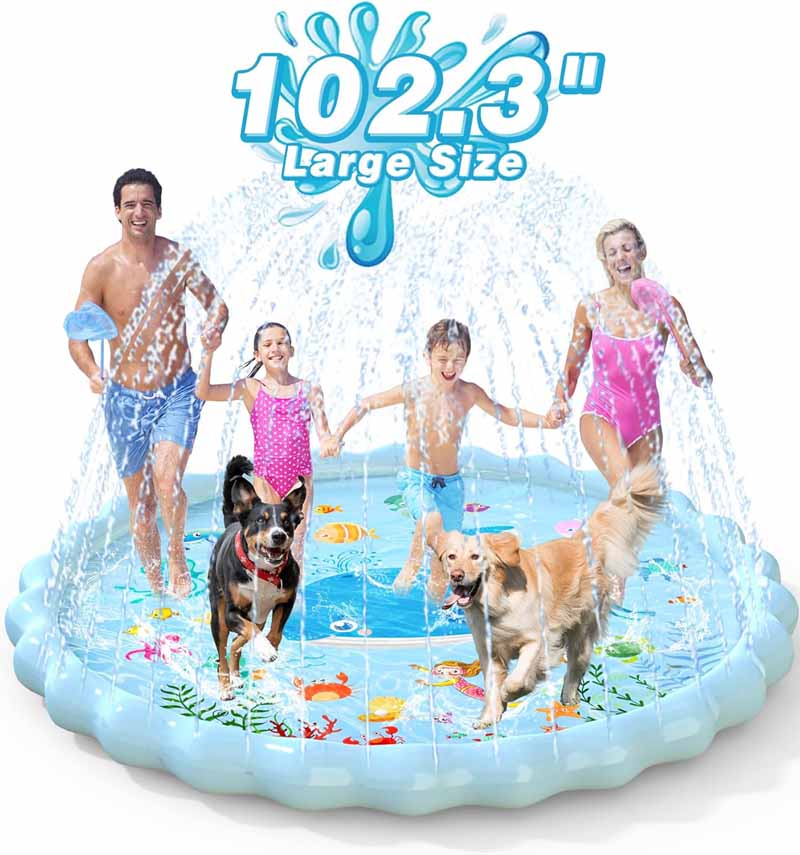
Product images often make a splash pad look spacious because children are carefully placed around the scene. Real play is rarely so organized. Children gather around a favorite spray, reach for the same toy, move across the center at the same time, and frequently step on or over the perimeter. A more useful capacity question is therefore not “How many children fit?” but “How many children can move naturally without constantly interfering with one another?”
For two children, moving from a compact pad into the 7–10-foot range can create noticeably more movement room, especially once they are past the toddler stage. For three or four children, layout becomes increasingly important. A wide, mostly open center often works better for group play than an equally large product with a bulky inflatable feature occupying much of the middle.
Age differences also affect capacity. Two toddlers may share a smaller pad comfortably because they move slowly and stay close to an adult. Two energetic seven- or eight-year-olds may need substantially more room. Families planning to keep a splash pad for several summers can reasonably choose some extra diameter, provided the larger size still fits the yard and remains practical to drain, dry, and store.
For birthday parties or larger gatherings, rotating children through the pad in smaller groups is often more comfortable than treating the product as an unlimited-capacity attraction. Space remains one of the simplest ways to reduce crowding and make water play feel more relaxed.
Bigger Is Not Always Better
A larger splash pad solves real problems when several siblings want to play together, when the family wants room for ball games, or when the backyard is regularly used for group activities. Outside those situations, extra diameter can introduce more work without improving the experience very much.
Every increase in size means a longer water channel, more PVC to handle, a larger area to clean, and more open space needed for drying. Large rings also depend more heavily on balanced water distribution. Water entering near the connector has farther to travel before reaching the opposite side, so ring geometry, spray-hole placement, household flow, and connector performance become more noticeable.
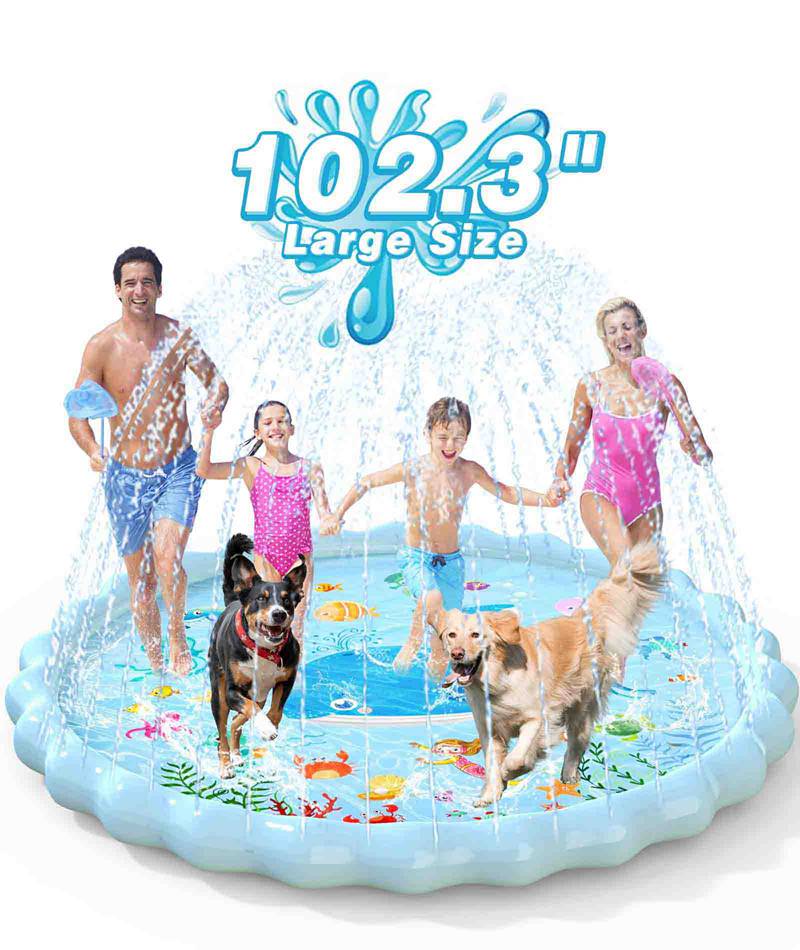
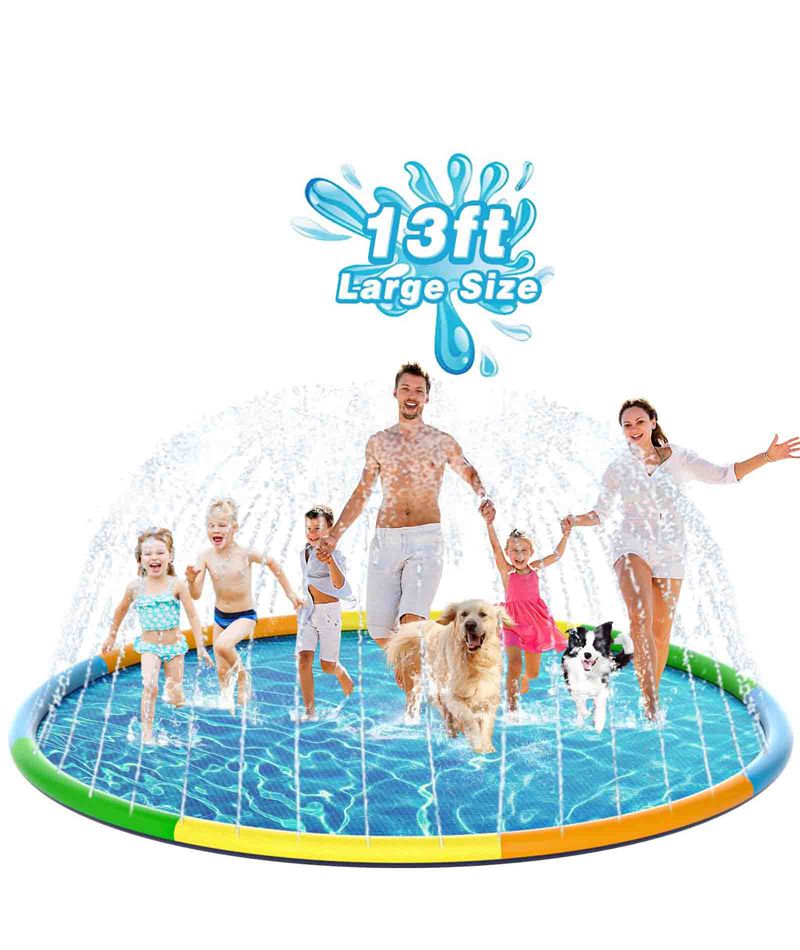
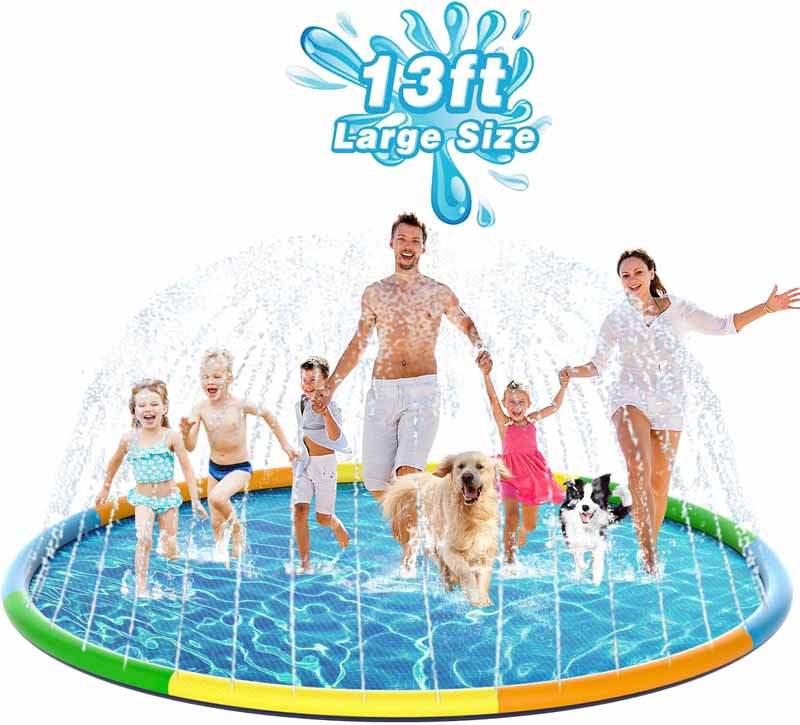
Large family formats—including products around 13 feet and above—can work very well in open yards where several children regularly play together. EPN develops both compact and larger PVC splash-pad formats for this reason: different households need different combinations of size, water distribution, and storage practicality rather than one universally “best” diameter.
The right size is therefore the smallest size that comfortably solves the family’s real space requirement. If additional diameter creates useful separation between siblings or supports the kind of games children actually play, it adds value. If most of the extra area will remain unused, it may simply create a larger product to drain and fold at the end of the afternoon.
Which Spray Features Improve Water Play?
The spray features that matter most are adjustable height, even distribution, inward-facing openings, and a dependable hose connection. Good water play does not require the tallest possible jets. It requires streams that can be set low for younger children, raised for more active play, and distributed consistently enough that one side of the splash pad does not feel completely different from the other.
Adjustable Height
Adjustability allows the same splash pad to suit different children and different days. A younger child trying water play for the first time may prefer a low spray that can be touched comfortably. Older siblings may want streams high enough to run through or reach overhead. Weather matters as well: strong water on a cool or windy afternoon can feel very different from the same setting on a hot day.
Flat splash pads generally control spray through household water flow rather than a separate powered pump. As water fills the perimeter ring, pressure pushes it through the small openings around the edge. Increasing faucet flow typically raises the streams, while reducing flow creates gentler spray.
This makes “maximum spray height” a poor way to judge quality by itself. The more useful measure is whether the product offers a comfortable adjustment range and remains reasonably balanced at normal household flow. Once the streams are high enough for the children to enjoy, additional water may only increase overspray and place extra pressure on the perimeter.
Starting at a low setting also helps diagnose the setup. Parents can see whether the ring is unfolded properly and whether each section is filling before higher pressure is applied. This is especially helpful with large pads that have been stored folded through winter.
Spray Pattern
The number of spray openings sounds like an easy comparison point, but more holes do not automatically produce better water play. Spacing, hole size, angle, perimeter geometry, and consistency have just as much influence on the final pattern. A carefully arranged series of openings can produce a more balanced curtain of water than a larger number placed without enough consideration for flow around the ring.
Inward-facing streams are particularly useful on family splash pads because they direct more of the water toward the central play zone. That keeps children interacting with the spray rather than forcing them to chase water landing outside the pad, and it reduces unnecessary soaking of nearby furniture or landscaping.
Larger pads make distribution more technically demanding. Water entering at one point must travel through a much longer channel, and the far side can become weaker if the design is not balanced. During product development, factors such as ring width, spray-hole spacing, inlet position, seam consistency, and overall diameter need to be considered together rather than scaling a small design up without adjustment.
| Spray Problem | Common Cause | First Thing to Check |
|---|---|---|
| One side is lower | Twisted or incompletely filled perimeter | Flatten the ring before adding more flow |
| All streams are weak | Restricted water flow or hose kink | Straighten the hose and check faucet output |
| Water leaks at inlet | Loose fitting or displaced washer | Reconnect and inspect the seal |
| Several jets spray sideways | Folded or distorted edge | Flatten material around the openings |
| Spray is too strong for a toddler | Faucet flow is too high | Reduce water gradually |
| Near side strong, far side weak | Uneven distribution in a large ring | Check full ring filling and available flow |

Hose Connection
The hose connector may be one of the smallest components on the product, but it deals with several loads at once. It must seal household water pressure, tolerate repeated attachment and removal, support some of the physical weight of the hose, and resist occasional sideways pulling when people move around the yard.
For U.S. households, compatibility with a standard garden hose makes setup much easier. Many splash pads use a 3/4-inch garden-hose-style connection or an adapter designed for that common system. A sealing washer inside the connector helps stop water escaping around the threads, while additional PVC or reinforcement around the inlet can help distribute mechanical load away from a small weld area.
Users should connect the hose firmly without using excessive force. If water continues leaking after normal tightening, inspect the sealing washer before twisting harder. A washer that is missing, folded, worn, or out of position can create a leak even when the connector itself is undamaged.
Hose routing matters as well. Leave some slack close to the splash pad instead of stretching the hose tightly from the faucet to the inlet. Reducing sideways tension makes the connection easier to keep sealed and places less stress on the flexible material surrounding it.
Water Pressure
Two families can connect the same splash pad and see different water heights because the pad is only the final part of the system. Faucet flow, household plumbing, hose diameter, hose length, elevation, kinks, connector restrictions, irrigation use, and other fixtures operating at the same time can all affect how much water reaches the perimeter channel.
A long hose can also reduce usable flow even when pressure at the outdoor faucet seems reasonable. This becomes more noticeable with large splash pads because the channel contains more volume and distributes water through more openings.
When spray appears weaker than expected, troubleshooting should begin with simple physical checks. Straighten the hose, confirm the connection is sealed, unfold the ring completely, and make sure another heavy outdoor water demand is not operating at the same time. Then increase flow gradually while watching the far side of the pad.
The goal is not to force the product to produce the highest possible spray. The best setting is the lowest household flow that creates a stable pattern children enjoy. That approach is easier on the water channel, reduces unnecessary overspray, and gives parents more control when younger and older children are sharing the same pad.
What Makes a Splash Pad Durable?
A durable splash pad combines appropriate PVC thickness with material flexibility, consistent welded seams, reinforcement around high-stress areas, a stable perimeter channel, and a dependable hose inlet. Thickness is useful to compare, but it cannot predict service life on its own. Many failures begin around connectors, seams, fold lines, corners, and abrasion points rather than in the middle of an otherwise undamaged sheet.
PVC Thickness
PVC thickness is one of the most visible construction specifications, so it is often treated as the main indicator of durability. It matters, but a thicker sheet with poor welds or a weak inlet can still fail early. A slightly lighter material combined with good formulation, consistent welding, and reinforcement in the right locations may perform better over repeated fill-and-drain cycles.
Flexible consumer splash pads frequently use films in roughly the 0.40–0.55 mm range, although there is no universal thickness requirement for every design. The appropriate material depends on diameter, ring geometry, expected user activity, portability, storage requirements, printing method, and cost. Around 0.50 mm is commonly used for more substantial family designs because it offers useful material body while remaining foldable.
Flexibility matters just as much as the number on a thickness specification. PVC repeatedly changes shape when the ring fills, children step near its edge, the pad drains, and the material is folded for storage. A film that becomes excessively stiff can concentrate stress at folds, while material that is too soft can stretch more than intended around pressure-bearing areas.
A balanced construction therefore considers thickness, formulation, welding behavior, printing, outdoor use, and folding together. EPN follows this kind of model-specific approach rather than using one material thickness as a blanket specification for every splash-pad size and structure.
Stress Points
The central printed surface covers most of the visible area, but it is not always where durability problems begin. Water pressure and mechanical loads are concentrated around the perimeter, hose connection, corners, spray openings, and repeated fold lines.
The inlet deserves particular attention because it combines water pressure with the physical force of the garden hose. If the hose is pulled tightly across the yard, the surrounding PVC may experience sideways load every time somebody moves the hose. A reinforced inlet or larger welded attachment area can spread that force more effectively.
The outer ring is another high-stress area because it repeatedly fills, expands, drains, collapses, and is stepped on during play. Spray holes are located inside that same pressure-bearing structure, so their placement and consistency affect both performance and local deformation.
| High-Stress Area | Typical Load | Useful Construction Detail |
|---|---|---|
| Hose inlet | Water pressure and hose pull | Reinforcement around connector |
| Outer ring | Pressure cycling and repeated stepping | Consistent seam and flexible material |
| Spray-hole area | Pressure and local bending | Clean, evenly formed openings |
| Corners | Concentrated structural tension | Smooth transitions and reliable welding |
| Fold lines | Repeated storage cycles | Flexible material and broad folding |
| Underside | Ground abrasion and puncture | Suitable thickness and clean placement |

Seam Quality
Most flat PVC splash pads rely on heat-based or high-frequency welding to create the perimeter channel rather than stitching it like a fabric product. The seam must join two material layers strongly enough to contain water pressure while allowing the surrounding film to remain flexible through repeated use.
Production quality depends on more than simply applying heat. Welding energy, pressure, contact time, electrode geometry, material formulation, surface cleanliness, and alignment all influence the bond. Too little energy may leave an incomplete weld, while excessive heat can distort or weaken the material beside the seam.
Consumers cannot inspect factory settings, but visible consistency still provides useful clues. A perimeter seam should look reasonably uniform without obvious gaps, severe wrinkles, burned sections, or badly misaligned layers. Once water is introduced, the ring should expand relatively evenly rather than creating one isolated bulge that is clearly different from the rest.
For product developers and private-label projects, seam testing deserves as much attention as artwork and material thickness. Increasing the diameter, changing the shape, or modifying the water channel can change loads on the seam, which is why reliable manufacturing requires structural decisions to be tested together rather than assumed to transfer perfectly from one model to another.
Storage Habits
Durability continues after the hose is disconnected. In many climates, a splash pad spends far more time folded in storage than it does operating in the yard. Putting it away wet, crushing it under heavy objects, or repeatedly making the same sharp fold can shorten useful life even when the original construction is sound.
After play, trapped water should be released by lifting or tilting sections of the perimeter. The pad should then be allowed to dry on both sides before long-term storage. Moisture trapped between folded PVC layers can contribute to odor, staining, and an unpleasant surface when the product is opened again.
Tighter is not always better when folding. A broad, organized fold generally places less concentrated stress on flexible material than forcing the product into the smallest possible package. Avoid pressing hard connectors directly into the PVC and consider changing the exact fold lines periodically instead of creasing the same narrow area every season.
Minor punctures also do not always mean the entire pad needs to be discarded. When the damage is small and away from a major structural failure, a repair system designed for flexible PVC can often restore basic function. The area should be cleaned, fully dried, and repaired according to the adhesive or patch instructions before water pressure is reapplied.
Which Convenience Features Matter Most?
The convenience features that matter most are straightforward hose setup, simple spray adjustment, efficient drainage, manageable drying, compact storage, and practical repair options. These features receive less attention than colors and themes, but they strongly influence how often parents actually use the splash pad. A product that is easy to prepare and put away can deliver more value over an entire summer.
Quick Setup
A splash pad works best as a spontaneous backyard activity. On a hot afternoon, parents should not need to spend a long time assembling frames, searching for specialized adapters, or troubleshooting several separate components before children can play.
For a flat sprinkler-style pad, setup should normally follow a simple sequence: clear the ground, unfold the product completely, position the water ring flat, connect the garden hose, begin with modest flow, and increase the water until the spray is balanced. Each step serves a practical purpose, but none should require specialized tools or technical knowledge.
Ground preparation is one of the easiest steps to skip because it happens before anything exciting starts. It is also one of the most valuable. A small sharp stone that takes ten seconds to remove can otherwise become the reason the pad needs repair later.
Connector simplicity has a similar effect on long-term use. Standard fittings, a properly seated washer, clear instructions, and a predictable inlet are far more useful than accessories that look impressive in the box but complicate normal setup. Convenience is not about removing every step; it is about making each necessary step obvious and repeatable.
Drain and Dry
The cleanup routine is where many outdoor water products either become family favorites or slowly disappear into storage. A pad that traps large amounts of water, takes excessive effort to lift, or cannot be dried easily may be used less frequently even if children enjoy it.
After the hose is disconnected, flexible water channels often retain small pockets of water. Lifting the far side and gradually working toward the outlet area usually helps release them. Families should avoid folding the product immediately after the visible top surface dries, because water can remain underneath or inside sections of the perimeter.
Grass, mud, sunscreen, food residue, and pet hair should be rinsed away when needed. Harsh household chemicals are not automatically appropriate for printed PVC, so cleaning should follow the product’s care instructions rather than assuming that stronger cleaners are better.
Drying space is another practical sizing consideration. A very large pad may fold compactly once dry but still need a substantial open area while moisture evaporates. Families with small patios, limited lawn, or no convenient drying area should consider this ownership step before automatically choosing the largest model.

Fold and Store
Flexible PVC allows a splash pad covering a large section of the yard to shrink into a relatively manageable package, but storage quality depends on what happens before it is folded. Drying comes first. Once the surfaces and water channel are dry, the pad can be folded broadly without forcing tight creases around the connector or perimeter seams.
Keep the small parts together. A sealing washer is easy to lose but important enough that its absence can make the following summer’s first setup frustrating. Repair patches, hose adapters, instructions, and storage bags should remain with the product rather than being spread across several garage drawers.
A quick inspection before long-term storage is useful as well. Look for tiny punctures, loose areas around the inlet, damaged accessories, or unusual seam changes while the product is still clean and accessible. Repairing a small issue before winter is easier than discovering it while children are already waiting beside the hose months later.
The best storage system is rarely complicated: clean, dry, inspect, fold, and protect. Families who follow those five steps are more likely to reopen the pad in good usable condition at the beginning of the next warm season.
Useful Extras
Accessories are worthwhile when they solve a real problem or extend the ways children can play. A storage bag helps keep everything together. A spare sealing washer can solve a simple connector leak. A correctly matched PVC patch provides a practical response to a minor puncture instead of turning small damage into immediate disposal.
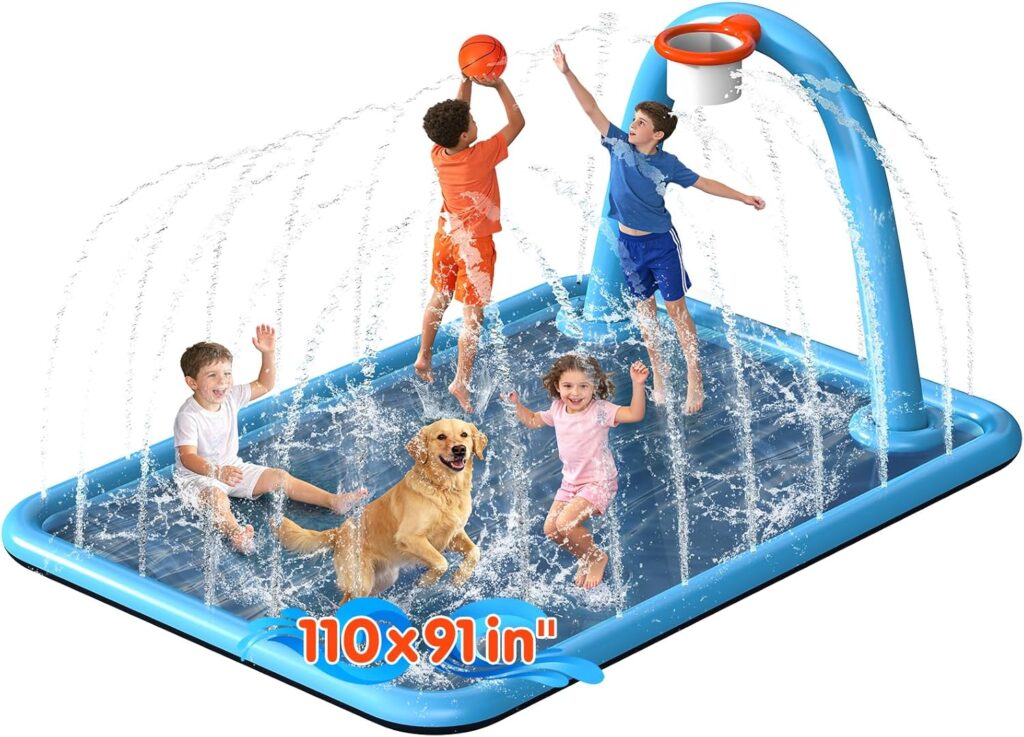
Interactive accessories can also add value. A soccer goal, soft ball, ring game, target, alphabet print, or themed graphic can keep children engaged longer and create play beyond simply standing in the water. These features are especially useful when they work with the size and layout of the pad rather than reducing too much of the usable center.
They should still come after the fundamentals. An impressive accessory kit cannot compensate for a weak hose connection, cramped play area, unreliable seam, or spray pattern that works well on only one side.
This balance also matters when developing custom products. Material thickness, play area, perimeter geometry, spray-hole layout, graphic design, connector construction, repair accessories, instructions, and packaging work best when they are considered together. For everyday families, the decision is simpler: prioritize the features you will notice every time the faucet is turned on, then choose the theme and extras your children will enjoy.
Conclusion
The most important splash-pad features are not necessarily the ones that create the most dramatic product photo. Families tend to appreciate quieter details over time: a wet surface that feels stable, enough space for children to move without constant collisions, spray that can be adjusted instead of simply turned “high,” a connector that stays sealed, seams that tolerate repeated summer use, and a pad that can be dried without turning cleanup into an evening project.
Start by comparing safety-oriented construction, usable dimensions, water control, PVC and seam quality, and normal ownership tasks such as drainage and storage. Then consider themes, games, graphics, and accessories. This order helps separate features that affect every use from features that mainly influence first impressions.
A cartoon shark, soccer print, or rainbow may be the reason a child first becomes excited about a splash pad. The reason a family keeps bringing it back onto the lawn is usually more practical: the product fits the yard, children have room to play, the spray behaves the way they expect, and putting everything away feels manageable. Those are the features that matter most after a full summer rather than only on the day the box arrives.
Frequently Asked Questions
Are splash pads safe for toddlers?
Splash pads can be suitable for toddlers when the product is intended for their age, the surface is placed on clean and level ground, water pressure begins at a gentle setting, and an adult stays close throughout play. A textured surface and controllable spray are useful, but they do not replace supervision. Toddlers should also be discouraged from deliberately swallowing splash-pad water.
How thick should a kids splash pad be?
Many flexible household splash pads use PVC films in approximately the 0.40–0.55 mm range, depending on product size and structure. Around 0.50 mm is common in more substantial family designs, but there is no universal ideal thickness. Seam quality, flexibility, connector reinforcement, ground conditions, and storage habits can influence durability just as much as the material thickness printed in the specification.
What size splash pad is best for two kids?
A 5–7-foot pad may work for two younger children who mainly sit and splash, while 7–10 feet usually provides more comfortable movement for active siblings. The usable center is more important than the outside diameter alone because perimeter rings and inflatable features reduce available play space. Older children generally benefit from more room than toddlers using the same product together.
Can you put a splash pad on concrete?
Some splash pads may be used on suitable patio surfaces if the manufacturer allows it, but smooth, clean, level ground is important. Rough concrete can abrade flexible PVC more quickly than grass, while dark paving can become very hot in direct sun. Before setup, remove sharp debris, check surface temperature, and consider whether the underside needs additional protection according to the product instructions.
How do you adjust the water pressure on a splash pad?
Most flat sprinkler pads use the household faucet to control spray height. Begin with low flow, allow the perimeter channel to fill, and increase gradually until streams become even and comfortable. If one side remains low, check the hose for kinks, flatten the water ring, inspect the connector for leakage, and make sure the edge is not folded before adding more pressure.
How do you keep a splash pad from getting moldy or smelling?
Drain as much water as possible after use, rinse away visible dirt or organic residue, and allow both sides of the pad to dry before folding. Moisture trapped between folded PVC layers can contribute to unpleasant odor and staining during storage. Long-term storage should be dry and protected from excessive heat, sharp objects, and heavy items pressing continuously against the folded material.
What is the most important feature in a kids splash pad?
No single specification should decide the purchase. For most families, the most important combination is a stable wet-play surface, suitable material and construction, enough usable space, adjustable spray, a dependable hose inlet, and straightforward cleanup. These features influence nearly every use, while themes, colors, and accessories mainly add entertainment once the practical fundamentals are already in place.