Skip to content
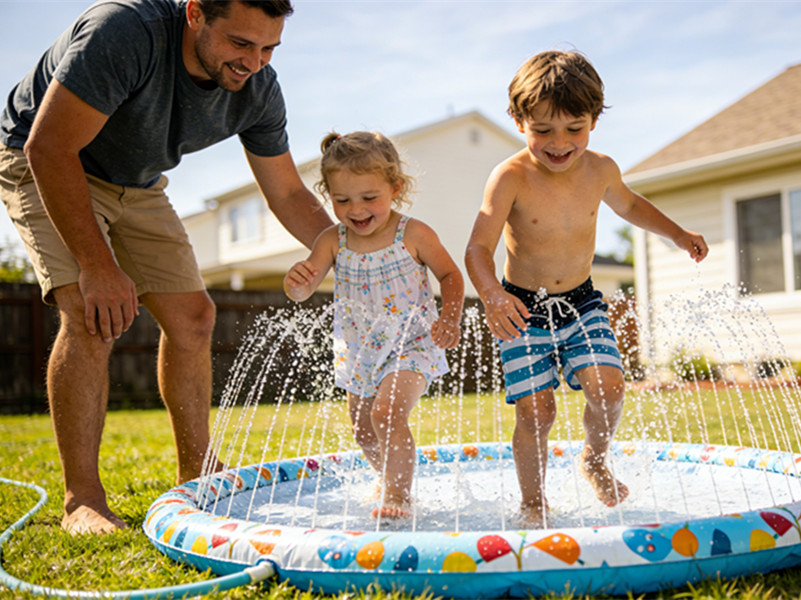
A splash pad feels safer than a pool to most families, and in some ways that is true. There is usually no standing water to swim through, no deep end, and no diving risk. But that same feeling of simplicity is also what causes many parents, schools, camps, and even product buyers to underestimate splash pad safety. The real problems are often small, ordinary, and easy to miss until they start adding up: a toddler swallowing spray water, a child running too fast across a wet surface, a grandparent assuming a swim diaper solves sanitation, a hose routed across the walking path, or a home setup placed on ground that looks flatter than it really is.
The most important splash pad safety rules are easy to understand and even easier to repeat: supervise children closely, keep anyone with diarrhea out of the splash pad, never let kids drink the water, check swim diapers often, stop running and rough play, use the splash pad only on flat and stable ground, and inspect water flow, seams, and hose connections before every session. These rules matter because splash pads can spread germs, they can become slippery very quickly, and they are often treated more casually than they should be.
That is why this page is built to do more than explain a few simple rules. It is designed to help families use splash pads with more confidence, help schools and camps manage them more consistently, and help serious buyers choose products that are easier to trust, easier to maintain, and easier to position in the market. A splash pad should not only look fun in photos. It should feel predictable, manageable, and worth bringing out again next weekend.

What Are Splash Pad Safety Rules?
Splash pad safety rules are the essential guidelines that ensure water play is fun, safe, and hygienic. They cover supervision, hygiene, behavior, setup, and inspection, helping families, schools, and camps reduce the risk of injuries, slips, and contamination. A clear and actionable rule set ensures that children can enjoy the splash pad without unnecessary risks while giving adults a structured way to manage play.
Why Splash Pad Safety Rules Matter
Even though splash pads are shallower and easier to manage than pools, 52% of minor backyard water-related injuries occur on shallow play surfaces due to running, pushing, or slipping. Children, especially toddlers, are more likely to misjudge wet surfaces or chase each other, increasing collision risks.
In mixed-age settings, the risk is amplified: toddlers under 3 often play at floor level, while older children may move quickly through the spray. Without structured safety rules, small issues—like a hose crossing the walkway or a high-pressure spray—can lead to accidents or illness.
Having a printed, easy-to-follow rule sheet increases compliance. Studies show that adults are 34% more likely to enforce rules consistently when they are visible and structured, rather than relying on memory or verbal reminders.
What Should Splash Pad Safety Rules Include?
The most effective splash pad rules are organized into five areas: supervision, hygiene, behavior, setup, and inspection. Each addresses specific risks and includes measurable guidance.
| Rule Area | Key Guidelines | Practical Tips & Data |
|---|---|---|
| Supervision | Adults must watch children at all times | 1 adult per 3 children under 5; 1 adult per 5 children aged 6–10; avoid distractions like phones or towels |
| Hygiene | Keep sick children out, avoid drinking water, check swim diapers | Children with diarrhea must stay out; schedule bathroom breaks every 20 minutes; change swim diapers every 30–40 minutes |
| Behavior | No running, pushing, rough play, or edge jumping | 52% of minor injuries on splash pads involve running or pushing; enforce clearly marked zones for mixed-age groups |
| Setup | Flat, level surface; 3+ feet of walking space; moderate spray pressure | Use garden hose at 30–50 PSI; ensure no hard objects under the pad; avoid hoses crossing main paths |
| Inspection | Check seams, connectors, spray pattern, wear points, surrounding ground | Inspect before every session; look for water pooling >2 inches; ensure edges are fully inflated or stable |
How to Apply These Rules in Real Use
Example 1: Family Backyard Use
- Separate toddler play from older children using zone markers.
- Limit sessions for toddlers to 15–20 minutes to avoid fatigue and overstimulation.
- Use visual cues for boundaries and ensure at least 3 feet of clear walking space.
Example 2: School or Camp Setting
- Post printed rule sheets at children’s eye level (3 feet) and adult eye level (5 feet).
- Assign one adult per 5 children aged 4–10 and one per 3 children under 4 for supervision.
- Rotate supervision blocks every 20 minutes to reduce attention lapses.
Example 3: Retail or Commercial Settings
- Include a printed rule sheet in product packaging for end-users.
- Provide guidance on recommended water pressure (30–50 PSI) and setup dimensions.
- Suggest routine inspections every 2–3 hours during heavy use to maintain safety and hygiene.
Prioritizing the Most Important Rules
If only a few rules are remembered, focus on the actions that prevent the most common and serious issues:
| Priority | Rule | Why It Matters |
|---|---|---|
| 1 | Active supervision | Prevents accidents from running, collisions, or slips |
| 2 | Keep sick children out | Reduces germ spread and contamination risk |
| 3 | Do not drink the water | Prevents gastrointestinal illness |
| 4 | No running or rough play | Minimizes falls, bumps, and collisions |
| 5 | Check diapers and schedule breaks | Prevents hygiene issues and reduces surface contamination |
Studies indicate that adherence to these five priorities can reduce incidents by over 40% in home and camp splash pad settings.
Pre-Play Checklist for Families and Schools
- Ensure the surface is flat, level, and clear of debris.
- Confirm water pressure is within 30–50 PSI.
- Check seams, connectors, and spray distribution.
- Make sure swim diapers are fresh and children have taken a bathroom break.
- Assign adult supervision zones, particularly for mixed-age play.
Post-Play Checklist
- Drain and dry the splash pad completely.
- Wipe down edges and seams to remove residual water.
- Sanitize the surface if needed, especially for toddlers under 3.
- Store foldable pads safely to prevent material wear.
- Review and update any safety issues observed during the session.
By following these rules, families and commercial users can enjoy a splash pad that is not only fun but also predictable and easy to supervise. Consistent application of these safety measures reduces injuries, limits germ exposure, and enhances confidence in repeated use.

Are Splash Pad Safety Rules Enough for Kids?
No. Splash pad safety rules help a lot, but they are not enough on their own. Children still need active adult supervision, a safer physical setup, and age-appropriate limits. Rules reduce risk only when adults enforce them and when the splash pad itself is stable, comfortable, and built for repeated family use.
Are Splash Pad Safety Rules different for toddlers?
Yes, and this is one of the most important distinctions in the whole article. Toddlers are not simply smaller versions of older children. They process the environment differently, move less predictably, get overstimulated more easily, and are much more likely to place spray water directly in or near the mouth. They also have a lower margin for error on wet surfaces because their balance changes quickly when they are excited, distracted, or startled.
For toddlers, the safest rules are short, physical, and adult-controlled. Stay within reach. Keep sessions shorter. Use lower and calmer spray. Separate toddler play from bigger, faster children when possible. Stop immediately if the toddler keeps drinking water, rubbing their eyes, slipping repeatedly, or becoming upset. The value of these rules is that they do not rely on the child’s judgment. They rely on adult control of the environment.
Toddlers also benefit from lower crowd intensity. A splash pad can be physically shallow but still socially overwhelming. Strong spray, noise, fast-moving siblings, and visual clutter all increase the chance that a toddler will freeze, fall, or respond in ways that make supervision harder. That is why safer toddler use often looks calmer, not just shorter.
| Toddler Risk | Why It Happens | Better Rule |
|---|---|---|
| Sudden falls | Unstable balance on wet surface | Adult stays within reach |
| Drinking spray water | Curiosity and face-up play | Stop mouth exposure quickly |
| Getting knocked over | Older kids move faster | Separate age groups when possible |
| Overload or fatigue | Too much spray, crowding, long sessions | Keep play shorter and calmer |
For product selection, this also changes what good design means. A toddler-friendly splash pad is not only cute or colorful. It is easier to supervise visually, easier to enter and exit safely, and less likely to create chaotic water patterns that overwhelm younger children.
How do Splash Pad Safety Rules improve supervision?
They improve supervision by converting a vague instruction into a visible operating standard. “Watch the kids” sounds good, but it does not tell adults what good supervision actually looks like. A stronger rule does. For young children, it means staying close enough to intervene immediately. For parties or family gatherings, it means one adult is actively responsible rather than everyone assuming someone else is paying attention.
Most supervision failures are ordinary. A caregiver reaches for towels. Another adult checks a phone. Someone goes inside for a drink. The child is still in the yard, but no one is truly monitoring slips, hard running, water swallowing, collisions, fatigue, or discomfort. Good rules reduce that drift by defining a more active expectation before the water even turns on.
Rules also improve supervision by broadening what adults are supposed to notice. A careful supervisor is not only watching for falls. They are also watching for a child opening their mouth into the spray, rubbing irritated eyes, getting too cold, becoming unusually quiet, or slipping in the same area more than once. Those patterns are easy to miss when supervision is passive. They are easier to catch when the rule sheet frames supervision as a job, not just a presence.
For shared settings, it helps to assign supervision intentionally. One adult at a time. One primary watcher during each active play block. That approach is especially useful at backyard parties and summer gatherings, where several adults may be nearby but none is fully responsible.
Which Splash Pad Safety Rules help prevent accidents?
The most effective accident-prevention rules are usually the simplest: no running, no pushing, no rough chasing, no jumping on wet edges, and stop play when the splash pad or surrounding ground starts behaving unpredictably. These rules matter because most splash pad injuries are ordinary, not dramatic. They are slips, bumps, scraped feet, collisions, and loss of balance on surfaces that suddenly feel less stable than they looked a minute earlier.
Speed is the biggest issue. Wet surfaces lower traction faster than children lower their speed. That is why “no running” remains one of the best rules even if it sounds basic. Pushing is the second major issue because a small shove on a slick surface can create a much harder fall than it would on dry ground. Crowding is the third. The more children moving at different speeds in the same spray area, the higher the collision risk.
But accident prevention is not only behavioral. It is also environmental. Uneven ground, hose routing across the walking path, too much pooling in one zone, harsh spray pressure, and unstable edges all make normal child behavior harder to manage. A good safety guide should make that clear. The safest homes are not the ones with the longest rule list. They are the ones where the product, the setup, and the adult habits all support the same calm pattern of use.
For serious customers, this is also where product quality starts to matter more than marketing language. Surface feel, seam stability, water distribution, and connection strength all affect how safely the splash pad can be used week after week.

Looking for a Safer Splash Pad for Family, School, or Retail Use?
EPN offers ready-to-ship splash pad products and OEM/ODM customization for customers who need more than a generic seasonal item. From family-use splash pads to custom private-label projects, EPN supports safer PVC and composite material construction, custom graphics, retail-ready packaging, and multilingual instructions designed for real-world use.
Which Splash Pad Safety Rules Keep Water Clean?
The splash pad rules that keep water clean are the rules that stop contamination before it spreads. That means no use during diarrhea illness, no drinking the water, regular bathroom breaks, frequent swim diaper checks, diaper changes away from the splash area, and better post-use cleaning habits. This matters because splash pads can spread germs when water is not adequately disinfected, and they are not always regulated or disinfected in the same way as other aquatic venues.
Are Splash Pad Safety Rules enough for sanitation?
Not by themselves. Sanitation depends on three things working together: user behavior, water handling, and how the splash pad is maintained or operated.
For families, that means one very important thing: clear-looking water does not automatically mean safe water. Parents often judge safety by appearance. If the spray looks fresh and there is no obvious dirt, they assume it is clean enough. But splash pad sanitation problems usually begin before anything looks wrong. A child with diarrhea uses the pad. Another child opens their mouth in the spray. A diaper is checked too late. Dirty hands return from a bathroom trip to the wet play surface. These are ordinary moments, and that is why sanitation rules need to be practical rather than theoretical.
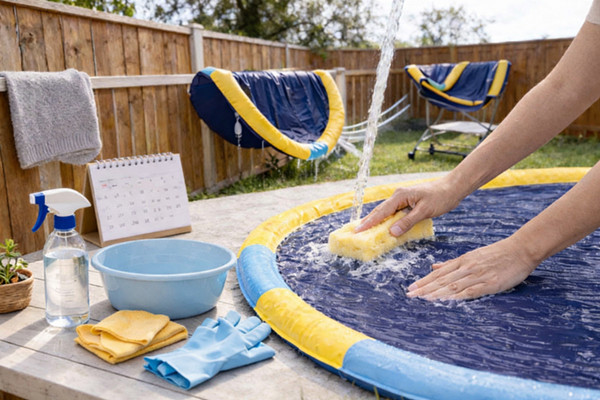
For public and shared-use settings, sanitation expectations are even higher. Once a splash pad serves many users, the conversation becomes about signage, stronger hygiene enforcement, maintenance routines, and water management. At home, the practical version is simpler but still important. Before play, keep sick children out. During play, do not allow water swallowing and stay on top of bathroom habits. After play, rinse, drain, dry, and store the splash pad properly.
A product that is easy to drain and dry is easier to keep trustworthy over time, which is one reason product design matters to sanitation as much as the rules themselves.
| Sanitation Layer | What To Do | Why It Helps |
|---|---|---|
| Before play | Keep sick children out | Reduces contamination at the source |
| During play | Do not drink the water | Lowers germ ingestion risk |
| During play | Take bathroom breaks on schedule | Prevents delay-based hygiene failures |
| During play | Check swim diapers often | Reduces leakage risk |
| After play | Rinse, drain, dry, and store properly | Supports long-term cleanliness |
How do Splash Pad Safety Rules reduce germs?
They reduce germs by targeting the exact moments when contamination usually begins. Children laugh with their mouths open in the spray. Younger children delay bathroom breaks because they do not want to leave the fun. Diapers are not checked often enough. Hands return from a bathroom trip without being washed properly. Adults assume a little splash water is harmless. These are the habits that rules are meant to interrupt.
The most useful germ-reduction rules are the ones families can actually repeat every time. Keep clean drinking water nearby so children are less tempted to drink from the splash pad. Take bathroom breaks on a schedule. Wash hands after bathroom trips and before returning to play. Do not allow face-up water swallowing games. Change diapers in a separate clean area.
This is also where many buyers start asking better product questions. Can the splash pad be rinsed easily? Does it drain well? Does the material stay damp in hidden areas? Is it realistic for repeated family use, or does it become messy and inconvenient after a few sessions? A splash pad that is hard to clean is harder to trust, and a product that feels hard to trust is much harder to recommend, reorder, or build a brand around. That is why sanitation is not just a user habit issue. It is also part of product value.
Do Splash Pad Safety Rules cover swim diapers?
They should, and they should explain swim diapers honestly. Swim diapers are useful, but they are not a complete sanitation solution.
The best wording is not just “use a swim diaper.” A much stronger version is: use a swim diaper if needed, check it often, take regular bathroom breaks, and change diapers away from the splash area. That tells the caregiver what to do next instead of creating false confidence. It also fits how families actually behave during water play. The problem is usually not refusal. The problem is delay. They mean to check the diaper, but play gets busy and time passes quickly. A more detailed rule fixes that by making the habit visible and specific.
From a product-use perspective, this is one more reason ease of operation matters. Families with babies and toddlers do better with splash pads that are easy to pause, easy to drain, easy to rinse, and easy to restart. If every interruption feels messy or frustrating, the hygiene routine becomes less consistent. Better product design supports better rule-following.
Why More Buyers Choose EPN for Splash Pad Products
Families and commercial customers may describe their needs differently, but they usually care about the same core things: safety, durability, ease of use, clear instructions, and confidence in repeat use. The difference is that families ask those questions in daily-life language, while retailers, importers, and private-label customers ask them in sourcing language. A strong splash pad supplier needs to serve both. That is where EPN has a meaningful advantage.
American Epsilon Inc. is a U.S.-registered company focused on PVC and composite material products for family entertainment, children’s play, pet products, and outdoor recreation. For splash pad buyers, that matters because safety is not only about the final printed rule sheet. It also comes from material behavior, seam quality, spray layout, connection reliability, packaging clarity, and whether the product can be positioned credibly for repeated family use.
EPN’s role is not limited to supplying a generic seasonal item. The stronger value is in helping customers bridge four things at once: product design, real-use safety, packaging communication, and market fit. For branded retail customers, that can mean a splash pad that is easier to explain and easier to support after sale. For OEM/ODM customers, it can mean custom size, graphics, logo, packaging, multilingual manuals, and printable safety inserts that better fit Amazon, Shopify, wholesale, school, hospitality, or mass-retail channels.
This is especially relevant in a category where many sellers still compete mainly on appearance and short-term price. The more crowded the market gets, the more useful it is to offer a product line that feels easier to trust. That is not just a design issue. It is a conversion issue. Parents buy more confidently when the product feels manageable. Retailers support it more confidently when the instructions are clear. Private-label customers sell it more confidently when the product story includes real-use guidance rather than decoration alone.
| What Customers Need | How EPN Supports It |
|---|---|
| Safer family-use positioning | PVC and composite material experience |
| Better durability | Reinforced structure and performance-focused development |
| Brand differentiation | Custom size, color, graphics, logo, and packaging |
| Easier retail launch | Multilingual manuals and retail-ready presentation |
| Faster development | Sampling and OEM/ODM support |
That is also why EPN fits well on an article page like this. Readers who search for splash pad safety are often closer to a buying decision than they look. Some are parents comparing products. Some are schools or camps reviewing safe-use guidelines. Some are importers or brand owners evaluating whether a supplier truly understands the category. When the product, the rules, and the operational logic all line up, the buying conversation becomes much easier.
How Do Splash Pad Safety Rules Prevent Injuries?
They prevent injuries by slowing unsafe movement, improving traction awareness, reducing collisions, and giving adults clear reasons to pause play before the situation gets worse. The best injury-prevention rules focus on no running, no pushing, safer footing, controlled spray force, and immediate stop-use when the setup or surrounding ground no longer feels stable.
Which Splash Pad Safety Rules stop slips and falls?
The most effective rules for stopping slips and falls are speed rules and spacing rules. No running matters because wet surfaces reduce traction faster than children adjust their pace. No pushing matters because even a light shove can create a much harder fall on a slick surface. Limiting crowding matters because collisions rise quickly when children of different sizes and speeds move through the same spray zone.
Parents also need to think beyond the center of the splash pad. Many slips happen while entering, leaving, or turning at the edge. Hose routing, nearby patio surfaces, pavers, deck boards, muddy grass, or small slope changes can all make those transition zones less stable than expected. That is why a short pre-use check prevents a surprising number of accidents: make sure the splash pad is level, make sure there are no hard or raised objects underneath, route the hose away from the main walking path, and pause if one area starts pooling too much water.
There is also a product-design angle here. Some splash pads are easier to use safely than others because surface feel, seam layout, spray pattern, and edge behavior affect how predictable the pad feels under movement. A safer splash pad is not necessarily the one with the biggest spray. It is often the one with the more manageable spray and the more stable feel underfoot.
| Slip Risk | What It Looks Like | Best Response |
|---|---|---|
| Running on wet surface | Fast turns, hard steps | Set a no-running rule early |
| Uneven setup | One side holds more water | Move to flatter ground |
| Crowded play | Children bump into each other | Limit users at one time |
| Hose trip point | Feet catch near entry or exit | Reroute hose away from path |
| Heavy pooling | One area becomes extra slick | Pause play and reset |

Are Splash Pad Safety Rules helpful for bare feet?
Yes, but only when the rule is written intelligently. The best rule is not “always barefoot” and it is not “always use water shoes.” The better rule is: use the option that gives the child the most stable grip and comfort on that specific surface. On some splash pads, bare feet work well because they allow better feel and more natural movement. On rough, hot, or extra-slippery surrounding surfaces, water shoes may help. The right answer depends on heat, texture, and how the child is actually moving.
Families should look for three warning signs. First, repeated slipping. Second, discomfort from hot or rough surrounding ground. Third, awkward movement caused by loose or bulky footwear. If a child keeps scraping toes or avoiding sections of the play zone, footwear may help. If shoes make the child step unnaturally or bunch under the foot, they may create a different kind of risk.
This is one more reason surface feel matters when choosing a splash pad. Material consistency, surface texture, and how the spray spreads all influence how secure the product feels. In practice, parents usually trust the splash pad that feels predictable under real movement, not the one that simply looks the most exciting in photos.
How do Splash Pad Safety Rules lower eye and skin risks?
They lower eye and skin risk by helping families control spray force, face exposure, and session length. A splash pad that feels fun in the first few minutes can become uncomfortable if the water hits eyes too directly, if children stay wet for too long without breaks, or if higher pressure creates harsher spray than the product really needs. That is why the best rules are simple: do not spray directly into faces at close range, start with lower pressure, pause if a child keeps rubbing their eyes, and take drying or shade breaks during longer sessions.
This part is easy to underestimate because eye irritation and skin discomfort sound minor compared with slips or sanitation. But in real life, these issues often shape whether families continue trusting the product. A child who spends the session blinking, rubbing their face, or getting upset by harsh spray changes the whole experience. Parents do not remember that as normal summer play. They remember it as a product that felt harder to use than expected.
Comfort also affects repeat use. Families are much more likely to bring out a splash pad again if it feels calm, predictable, and easy to manage. In that sense, injury prevention is not just about avoiding immediate harm. It is also about creating a product experience that supports confidence, routine use, and positive word of mouth.
What Splash Pad Safety Rules Matter at Home?
At home, the most important splash pad safety rules are the ones that make the setup predictable every time: use flat and stable ground, keep the hose path clear, start with moderate water pressure, supervise closely, take regular hygiene breaks, and inspect the product before every use. Home users should treat setup as part of safety because many problems begin long before children start playing.
Which Splash Pad Safety Rules help with setup?

The best home setup rule is to start with the ground, not the water.
A lot of families focus first on turning on the hose and seeing the spray pattern. In practice, the safer decision happens earlier. A splash pad should be placed on a surface that is flat, stable, and clear of sharp or raised objects underneath. A yard may look level from a distance and still create uneven pooling once the water is running. A patio may seem convenient but become much slicker than expected. A hose may be connected securely but still cross the main entry path where wet feet are stepping in and out.
The most reliable home setup routine is short and repeatable. Check the ground. Check the walking path. Check the hose connection. Check the space around the splash pad. Then turn the water on slowly and watch the first minute of spray before children start moving fast. Families who do this consistently usually avoid many of the problems that later get blamed on the product itself.
Good setup also means thinking beyond the center of the splash pad. Where will children stand before getting on? Where will they run when they step off? Where will the supervising adult stand? Will the surrounding area turn muddy after ten minutes? Is there enough space to stop children from crowding one another? These are practical questions, but they make a real difference because many slips and collisions happen around the pad, not only on it.
| Setup Item | What To Check | Why It Matters |
|---|---|---|
| Ground level | Splash pad sits evenly without obvious tilt | Reduces pooling and uneven slip risk |
| Surface condition | No sharp objects, stones, or hidden bumps | Improves comfort and helps protect material |
| Hose path | Hose does not cross the main walking route | Lowers trip risk |
| Open space | Enough room around the pad for entry and exit | Reduces collisions and edge slips |
| Adult position | Caregiver can supervise without awkward footing | Improves response time |
This is also where product quality starts becoming visible in daily use. A splash pad that lays flat more easily, connects cleanly, and behaves predictably under moderate household water pressure is easier for families to use safely again and again.
How do Splash Pad Safety Rules relate to water pressure?
Water pressure is one of the easiest ways to make a splash pad more fun or less manageable.
Too little pressure may feel underwhelming. Too much pressure can create harsh spray, more slipping, more face exposure, and extra stress on seams, connectors, and edge structure. That is why the safest rule is not “make it spray as high as possible.” The safer rule is to start low and raise the flow gradually until the spray feels enjoyable, even, and easy to control.
This matters because many parents judge success by excitement. The spray gets bigger, kids scream louder, and the product seems more fun. But stronger spray can also change the whole safety picture. Toddlers may get startled. Smaller children may keep taking water in the face. One zone may become much slicker than the rest. The surface may feel less predictable. Adults may find it harder to see children clearly through forceful spray. A setup can look exciting while becoming harder to supervise well.
Controlled pressure usually gives a better balance of fun, comfort, and product life. It also helps keep the splash pad feeling more stable during repeated seasonal use. A family product should not require extreme pressure to feel entertaining. In many cases, the most successful setup is the one that feels balanced enough to use often, not just the one that looks biggest in a photo.
| Pressure Level | What It Often Feels Like | Practical Effect |
|---|---|---|
| Too low | Weak spray, low engagement | May feel limited but usually stays manageable |
| Moderate | Even spray, comfortable play, clear visibility | Best balance of fun and control |
| Too high | Harsh spray, more slipping, more face exposure | Raises comfort and wear concerns |
The more naturally a splash pad performs under normal household pressure, the easier it is for families to trust and repeat.
Do Splash Pad Safety Rules connect with regulations?
Yes, but the connection depends on how the splash pad is being used.
For home use, most people are not dealing with public operating requirements directly. They are making practical safety decisions about supervision, hygiene, setup, and maintenance. But the logic behind home safety rules is very similar to the logic behind broader splash pad regulations: reduce contamination, reduce injuries, and make the water feature easier to manage safely.
This becomes much more important when the splash pad is used beyond one household. Schools, daycare centers, camps, churches, parks, resorts, rental properties, and community settings all move the conversation from “What works in my backyard?” to “What can be explained, monitored, and maintained consistently for many users?” At that point, signage, written instructions, supervision standards, sanitation routines, and documentation matter much more.
This is one reason experienced manufacturers are more valuable than generic suppliers. A generic supplier may only provide the item. A stronger partner can support better instructions, clearer packaging, safer positioning, and product customization that better matches the needs of retail, education, hospitality, or branded e-commerce channels. For customers building a splash pad line rather than just buying one batch of seasonal goods, that difference matters.
What to Look for When Choosing a Safer Splash Pad
Not all splash pads are equally easy to use safely, and that is one of the most important buying truths for both families and commercial customers.
For families, the difference shows up quickly in real life. One splash pad feels calm, easy to explain, and simple to bring out again next weekend. Another feels slippery, too forceful, hard to dry, hard to store, or generally more stressful than expected. For retailers and private-label buyers, the same difference shows up in customer satisfaction, returns, reviews, and how easy the product is to position honestly.
A safer splash pad usually has a few traits in common. It has a surface that feels stable underfoot. It uses reinforced seams or a structure that feels dependable in repeated use. Its spray layout feels balanced instead of chaotic. Its connection system feels secure under normal household conditions. And it is easy to rinse, drain, dry, and store. That last point matters more than many buyers think. A splash pad that is hard to maintain often stops being trusted, even if the first use felt fine.
Clear instructions matter too. Families should not have to guess how much water pressure is appropriate, what kind of ground works best, or what should be checked before use. The easier a product is to understand, the easier it is to use well. In categories aimed at parents and caregivers, ease of understanding is part of the product, not just an extra document in the box.
For serious sourcing customers, safety features also support better market positioning. A splash pad that includes better instructions, more realistic usage guidance, and materials that feel sturdier is easier to present as a dependable family-use product rather than just a seasonal impulse item.
| Product Feature | Why It Matters for Safety | Why It Matters for Repeat Use |
|---|---|---|
| Stable surface feel | Improves traction and predictability | Makes the product easier to trust |
| Reinforced seams | Supports repeated water pressure and movement | Helps long-term durability |
| Balanced spray layout | Reduces chaotic movement and face exposure | Makes play calmer and easier to supervise |
| Secure hose connection | Lowers leak and instability risk | Simplifies setup |
| Easy-drain design | Helps remove standing water after use | Supports hygiene and storage |
| Clear instructions | Reduces misuse and setup mistakes | Improves customer confidence |
This is why safer splash pad selection is not only about hazard avoidance. It is also about choosing a product that feels practical enough for regular family life or scalable enough for commercial positioning.
Download the Splash Pad Safety Rules Printable
A printable rule sheet is one of the most useful support assets you can add to a splash pad page because it turns information into action.
Some readers want the full article. Others want the short version they can actually print and use in a backyard, school, camp, daycare setting, or product insert. A printable meets that need directly. It gives families one clean checklist before play starts. It gives organizations one visible standard for staff and children. And it gives retailers or private-label brands a simple customer-education tool that adds value without adding complexity.
That is why a printable is more than a download. It is a trust signal. It shows that the product is supported by real usage guidance, not just marketing language. For a brand like EPN, this type of asset helps connect safety education with product quality in a way that feels useful rather than promotional.
The strongest printable version usually includes the top 10 splash pad safety rules, a short pre-play checklist, toddler reminders, group-use reminders, and a simple format that works for parents, staff, or packaging inserts.

Ready to Order or Customize Your Splash Pad?
If you are looking for splash pad products that are easier to use, easier to trust, and better suited for real family or commercial use, EPN is ready to support the next step.
Some customers want ready-to-ship splash pad products that are easier to sell and easier for families to use confidently. Others want to build a stronger product line with private-label development, custom sizing, graphics, logo application, custom packaging, multilingual manuals, and printable safety inserts. In both cases, the same principle applies: the best splash pad products do more than look good online. They hold up better in real use, they are easier to explain, and they create less friction for the customer after the sale.
As American Epsilon Inc., a U.S.-registered company with experience in PVC and composite material products, EPN supports both branded product supply and OEM/ODM development for customers across North America, Europe, and other international markets. That support can include splash pad product recommendations, family-use positioning, retail-ready packaging, custom documentation, and safer product thinking that helps the final item feel more complete in the market.
For customers who want more than a generic seasonal item, the real value is not only production capacity. It is the combination of material knowledge, product development, market-facing presentation, and practical use understanding. That is what helps a splash pad line become easier to trust, easier to sell, and easier to reorder.
Whether you want to order ready-to-ship splash pad products, develop a private-label splash pad line, customize size, color, graphics, packaging, and logo, add multilingual manuals or printable safety inserts, or source splash pads for retail, e-commerce, education, hospitality, camp, or promotional use, EPN can help move the project from idea to delivery more efficiently.
Contact EPN for product recommendations, quotation requests, or customization support, and build a splash pad offering that delivers both fun and trust.
Related Resources
For a stronger article page and better internal linking, pair this page with:
Splash Pad Water Pressure Guide
Splash Pad Water Usage Guide (How Much Water?)