Skip to content
A lot of people think a punching bag is just a punching bag. In real life, that is where many bad buying decisions begin. A parent buys a hard heavy bag for a young child and quickly realizes it is too aggressive. A beginner orders a professional gym bag and then finds out it is too loud, too heavy, and too difficult to install. A retailer sees strong demand for “boxing bags” but misses the fact that customers searching online are usually not all looking for the same thing. Some want stress relief. Some want fitness. Some want safe indoor play for kids. Some want a compact training tool for a spare room, garage, balcony, or backyard.
The short answer is this: the main types of punching bags are heavy punching bags, free-standing punching bags, speed punching bags, double-end punching bags, water punching bags, and inflatable punching bags. The best choice depends on who will use it, how much space is available, how much impact the user wants, and whether safety, portability, or commercial resale matters most.
That is why this topic matters more than it first appears. The right punching bag can turn exercise into a daily habit, make a kids’ product safer and more appealing, and help a brand enter a profitable category with fewer returns and better reviews. The wrong one usually does the opposite. Once you understand how each type works, the differences become very clear, and choosing gets much easier.
What Is a Punching Bag?
A punching bag is a strike-training product designed to absorb repeated punches, allowing users to practice boxing techniques, improve coordination, and perform high-intensity workouts without needing a partner. While the concept sounds simple, punching bags today serve several different roles depending on who uses them. In boxing gyms they are used for power and technical training. In homes they are often part of a cardio fitness routine. For children and beginners they can be a fun way to stay active while building basic movement skills.
Most punching bags are designed to withstand thousands of repeated impacts. To achieve this, manufacturers use durable outer materials and carefully engineered internal structures. Traditional boxing bags often contain tightly packed fabric, foam, or sand. Inflatable punching bags use air chambers and flexible materials that bend and rebound after impact.
The global boxing equipment market has grown steadily over the last decade. Industry estimates suggest that millions of punching bags are sold every year through sporting goods retailers, online marketplaces, and fitness equipment suppliers. Much of this growth comes from home fitness users rather than professional fighters. Consumers increasingly choose compact training equipment that can be used in small spaces without requiring expensive gym memberships.
Understanding what a punching bag actually does—and how different types behave—helps customers choose equipment that matches their goals. Some bags focus on strength training, while others emphasize speed, coordination, or recreational exercise.
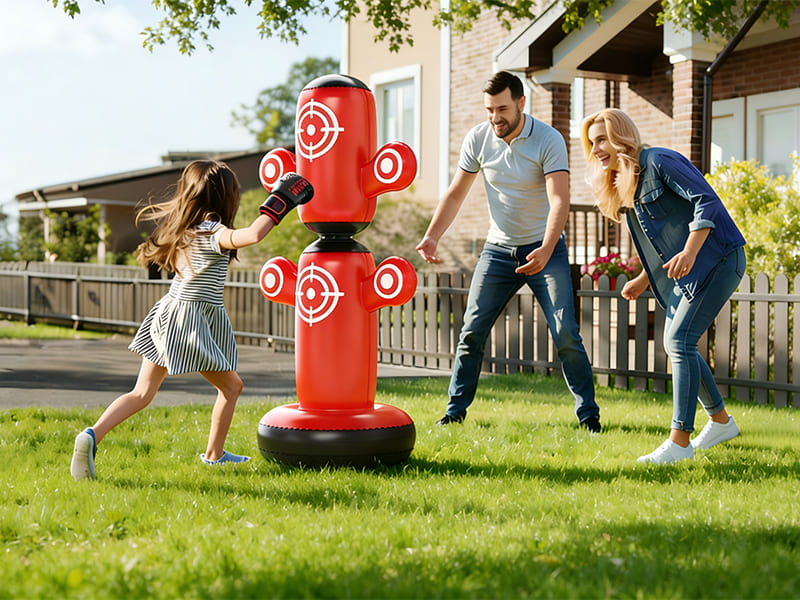
What Is a Punching Bag Used For?
People buy punching bags for several practical reasons. The most common use is practicing boxing or martial arts strikes. A punching bag allows users to repeat punches over and over, improving muscle memory and body coordination.
In a typical boxing workout, users practice combinations of punches such as jabs, crosses, hooks, and uppercuts. These movements engage many muscle groups simultaneously. Shoulders, arms, chest, back, core, and legs all contribute to the motion. Because of this full-body engagement, punching bag workouts are widely used in fitness training programs.
For adult fitness users, one reason punching bags continue to sell well is that they fit neatly into current exercise habits. U.S. public-health guidance still emphasizes at least 150 minutes of moderate-intensity physical activity per week for adults, plus muscle-strengthening activity on at least two days a week. A well-designed punching bag workout can help users work toward both goals.
Studies of boxing-style workouts show that a moderate punching bag session can burn 400–700 calories per hour, depending on intensity and body weight. This makes punching bags popular for cardio exercise and weight management.
Beyond fitness, punching bags are also used for stress relief. Many people enjoy the physical release of striking a bag after a long day at work. Fitness instructors often incorporate bag training into interval workouts because it combines cardiovascular exercise with strength and coordination.
Punching bags are also used in youth sports training and physical education programs. Children can practice balance, hand-eye coordination, and controlled movement while staying physically active. That is why home-focused punching bags are no longer a niche. They now serve a broad range of users, including beginners, women, teens, and parents shopping for active indoor play.
According to current physical activity recommendations for children, young people should engage in at least 60 minutes of physical activity every day, which is why products that make movement fun, simple, and repeatable are becoming increasingly valuable in family purchasing decisions.
Regular physical activity helps improve cardiovascular health, coordination, and overall physical development in children, making active play equipment increasingly important in modern households.
Is a Punching Bag Good for Home Training?
Punching bags are widely used in home workouts because they provide a combination of cardio exercise, strength training, and coordination practice without requiring large equipment.
Many home fitness users prefer punching bags because they offer high workout intensity in a relatively small space. A training area of about 5–6 feet in diameter is usually enough for most punching bag workouts.
Another advantage is simplicity. Unlike machines that require complicated setup, many punching bags can be assembled in minutes. Free-standing punching bags only require filling the base with water or sand, while inflatable punching bags can be inflated with a hand pump.
However, the type of punching bag matters for home environments. Heavy punching bags require ceiling mounts and can create vibration when struck repeatedly. This can be inconvenient in apartments or shared living spaces.
Free-standing and inflatable punching bags are often preferred for home use because they are easier to install and move. Some models can even be deflated or stored when not in use.
Does a Punching Bag Build Strength?
Training with a punching bag can build both muscular strength and endurance. When a person throws a punch, the motion begins in the legs and travels through the hips, core, shoulders, and arms. This chain of movement activates multiple muscle groups simultaneously.
A heavy punching bag offers the highest resistance, which helps develop punching power and upper-body strength. Repeated strikes against a resistant surface require stabilization from the shoulders and core, strengthening these muscles over time.
Speed and coordination training also contribute to endurance. When users perform punching combinations for multiple rounds, their heart rate increases significantly. This makes punching bag training both a strength and cardiovascular workout.
Typical muscle groups involved in punching bag training include:
| Muscle Group | Function During Punching |
|---|---|
| Shoulders | Drive forward arm motion |
| Chest | Support punching force |
| Core muscles | Stabilize torso rotation |
| Back muscles | Control recoil and balance |
| Legs and hips | Generate power through body rotation |
Because punching bag training combines strength and cardio movement, it is commonly used in boxing gyms, martial arts studios, and home fitness routines.
What Punches Work on a Punching Bag?
Most punching bag workouts focus on four basic boxing punches. These punches form the foundation of striking technique and are used in both beginner and professional training.
The four fundamental punches are:
| Punch | Description | Training Benefit |
|---|---|---|
| Jab | Quick straight punch with lead hand | Improves speed and distance control |
| Cross | Powerful straight punch from rear hand | Develops maximum punching power |
| Hook | Circular punch targeting side of opponent | Builds rotational strength |
| Uppercut | Upward punch aimed at chin or body | Improves close-range power |
Practicing these punches repeatedly on a punching bag helps develop rhythm, timing, and accuracy. Beginners often start with simple combinations such as jab–cross before progressing to more complex punching patterns.
For children or beginners, softer punching bags allow them to practice these movements safely while learning proper body mechanics.
In many training programs, punching bag workouts are organized into rounds lasting two to three minutes, followed by short rest periods. This format mirrors boxing match conditions while also providing an effective interval workout.
By understanding how punching bags are used and what movements they support, customers can make more informed decisions when selecting the right equipment for their needs.
Types of Punching Bags
Punching bags come in several different designs, and each one behaves differently when struck. The differences may seem small at first glance, but they strongly affect training experience, safety, and the type of user the bag is suitable for. For example, a professional boxer training for power usually prefers a dense heavy bag, while a beginner or family buyer may prefer a softer inflatable punching bag that rebounds after impact.
In the global fitness and sports equipment market, punching bags are generally grouped into six main categories: heavy punching bags, free-standing punching bags, speed punching bags, double-end punching bags, water punching bags, and inflatable punching bags. Each type serves a different purpose such as strength training, coordination practice, or recreational exercise.
For customers comparing options, several practical factors often influence the decision:
- how much space is available
• whether ceiling installation is possible
• the age and strength of the user
• desired workout intensity
• storage and portability needs
The table below summarizes how these punching bag types differ in practical use.
| Punching Bag Type | Typical Weight or Structure | Installation | Best For | Main Advantage |
|---|---|---|---|---|
| Heavy punching bag | 70–150 lb filled bag | Ceiling mount or stand | Power training | Strong resistance |
| Free-standing punching bag | Upright bag with weighted base | Floor placement | Home fitness | Easy installation |
| Speed punching bag | Small fast-rebound bag | Platform mount | Coordination training | Improves rhythm |
| Double-end punching bag | Bag attached by elastic cords | Ceiling and floor anchors | Accuracy training | Reactive movement |
| Water punching bag | Water-filled heavy bag | Ceiling mount | Impact training | Realistic feel |
| Inflatable punching bag | Air-filled body with weighted base | Floor placement | Kids and beginners | Safe rebound |
Understanding these categories helps buyers select a product that matches their needs instead of choosing only by appearance or price.
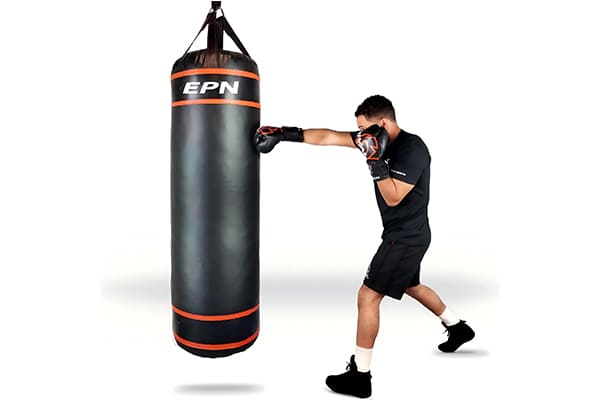
Heavy Punching Bag
The heavy punching bag is the most traditional and widely recognized type of punching bag. It is usually made from synthetic leather or canvas and filled with compressed fabric, foam, or sand. Most heavy punching bags weigh between 70 and 150 pounds (32–68 kg).
Because of their dense filling, heavy bags provide strong resistance. This makes them ideal for practicing powerful punches and developing upper-body strength. When struck, the bag swings slightly, forcing the user to adjust their stance and maintain balance.
Heavy punching bags are commonly used in:
- boxing gyms and martial arts studios
• strength training workouts
• professional boxing practice
However, heavy bags require a solid mounting system. They are typically attached to ceiling beams using chains or heavy-duty brackets. Without proper support, the repeated impact forces can damage ceilings or create vibration.
For home users, heavy punching bags are best suited for garages, basements, or dedicated workout rooms where installation is easier.
Typical heavy punching bag specifications are shown below.
| Feature | Typical Range |
|---|---|
| Bag height | 4–6 feet |
| Weight | 70–150 pounds |
| Outer material | Synthetic leather or canvas |
| Mounting method | Ceiling mount or heavy stand |
| Main training purpose | Power and endurance |
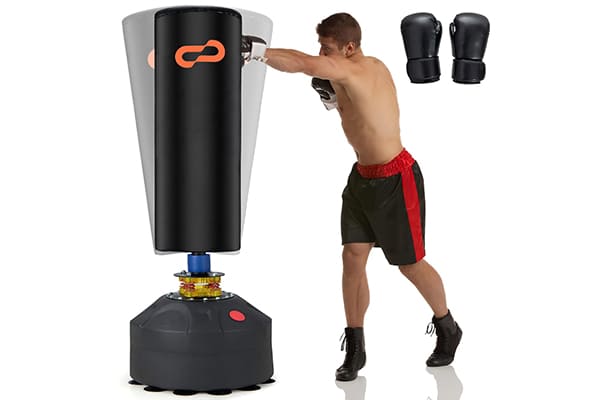
Free-Standing Punching Bag
A free-standing punching bag is designed for users who want a punching bag without installing ceiling hardware. Instead of hanging from above, the bag is connected to a base that is filled with water or sand.
Once the base is filled, the bag becomes stable enough for repeated punching. The striking portion bends slightly after impact and then returns to its upright position.
Free-standing punching bags are especially popular for home fitness environments because they are simple to set up and move. Many models can be assembled in less than 15 minutes, making them convenient for beginners.
They are often used for:
- cardio boxing workouts
• beginner training
• home gyms and apartment fitness spaces
Typical specifications for consumer free-standing punching bags include:
| Feature | Typical Specification |
|---|---|
| Height | 60–72 inches |
| Base diameter | 18–24 inches |
| Base weight (filled) | 120–200 pounds |
| Material | Foam core with synthetic cover |
| Training style | Fitness and beginner boxing |
One drawback is that very powerful punches can cause the base to shift slightly on smooth floors. Rubber floor mats are often recommended to improve stability.
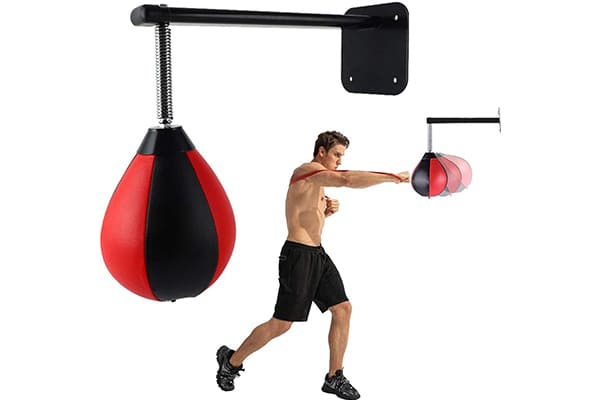
Speed Punching Bag
The speed punching bag is smaller and lighter than most punching bags and is designed to rebound quickly after each strike. It is usually mounted on a wooden platform attached to a wall or stand.
When struck correctly, the bag moves in a rapid back-and-forth rhythm. Maintaining this rhythm requires coordination and timing. Because of this, speed punching bags are widely used for training hand speed and reflexes.
Speed punching bags are commonly used in boxing gyms to help athletes develop:
- hand-eye coordination
• timing and rhythm
• shoulder endurance
Unlike heavy bags, speed bags are not designed for power training. Their small size and fast rebound make them more suitable for technical skill development.
Typical speed bag characteristics include:
| Feature | Typical Range |
|---|---|
| Bag height | 9–11 inches |
| Weight | 1–3 pounds |
| Mounting | Platform board |
| Rebound speed | Very fast |
| Training focus | Speed and coordination |
Double-End Punching Bag
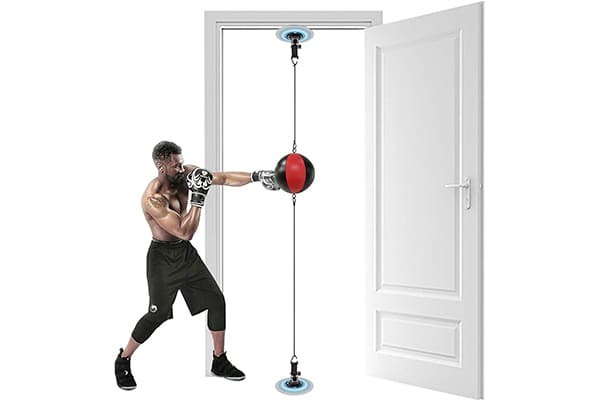
A double-end punching bag is attached to both the ceiling and the floor using elastic cords. This setup creates a floating target that moves quickly when struck.
Because the bag reacts unpredictably, users must adjust their punches to hit the moving target. This helps improve accuracy and reaction time.
Double-end punching bags are especially useful for:
- precision training
• defensive movement practice
• reflex development
Many boxing coaches use double-end bags to teach fighters how to control their distance and maintain focus during fast movements.
Typical specifications include:
| Feature | Typical Range |
|---|---|
| Bag size | 7–10 inches |
| Attachment | Elastic cords top and bottom |
| Movement | Rapid multi-direction rebound |
| Training focus | Accuracy and reflexes |
Although effective for skill development, double-end punching bags can be difficult for beginners because they require precise timing.
Water Punching Bag
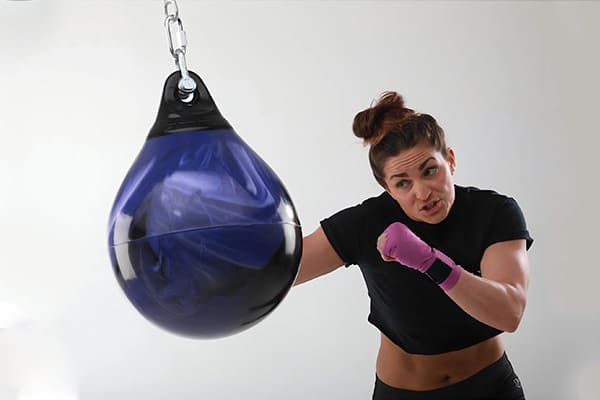
Water punching bags are a specialized type of heavy bag filled with water rather than fabric or foam. The water distributes impact evenly throughout the bag, creating a smoother and more natural striking feel.
Many athletes prefer water bags because they mimic the resistance of a human body more closely than traditional heavy bags.
Advantages of water punching bags include:
- reduced joint stress due to fluid impact absorption
• consistent weight distribution
• durable outer shell
Typical water punching bag features include:
| Feature | Typical Range |
|---|---|
| Weight (filled) | 80–120 pounds |
| Material | Reinforced vinyl |
| Mounting | Ceiling mount |
| Impact feel | Dense but fluid |
However, water punching bags still require strong ceiling mounting and are generally used by more experienced users.
Inflatable Punching Bag
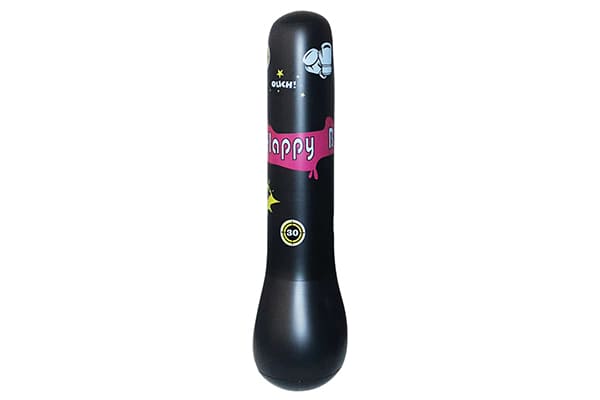
Inflatable punching bags are one of the most accessible types of punching bags for beginners and children. These bags use air-filled chambers to create a flexible striking surface, combined with a base that can be filled with water or sand for stability.
When punched, the bag bends and then rebounds upright. This rebound effect creates an engaging and safe training experience.
Inflatable punching bags are widely used for:
- children’s physical activity
• beginner boxing practice
• recreational fitness
• indoor or backyard play
Typical inflatable punching bag characteristics include:
| Feature | Typical Specification |
|---|---|
| Height | 47–65 inches |
| Material | PVC or composite vinyl |
| Base filling | Water or sand |
| Weight when filled | 15–30 pounds |
| Recommended users | Kids and beginners |
Because inflatable punching bags are lightweight and easy to store, they are frequently sold through online marketplaces and retail stores targeting families and beginner fitness users.
For many customers, inflatable punching bags offer a practical balance between exercise and entertainment, making them one of the most versatile products in the punching bag category.
To better understand how an inflatable punching bag works in real life, the video below shows a kids inflatable punching bag designed for beginner training and active play.
Unlike traditional heavy punching bags, inflatable models are lighter and use an air-filled body combined with a weighted base. This design allows the bag to bounce back safely after each punch, making it especially suitable for children and first-time users.
As shown in the video, inflatable punching bags rebound quickly after impact, allowing users to continue punching without the bag falling over. This rebound feature is one of the reasons why inflatable punching bags have become increasingly popular for home fitness and children’s training.
Best Punching Bag for Beginners
For beginners, the most suitable punching bag is one that allows users to practice basic punches safely while building coordination, endurance, and confidence. New users typically benefit from punching bags that offer moderate resistance, stable rebound, and simple setup, rather than extremely heavy or highly technical equipment. A beginner-friendly bag should allow repeated practice without causing wrist strain or discouragement.
Many new users begin punching bag training for fitness rather than competitive boxing. In this context, the equipment should support learning basic movements, improving cardiovascular fitness, and developing rhythm during exercise. Boxing-style workouts are widely recognized as an effective full-body activity that can improve cardiovascular health, muscular endurance, and coordination at the same time.
Beginners also tend to train in shorter rounds. A typical entry-level session might involve 3-minute punching rounds followed by 30–60 seconds of rest, repeated several times. This format allows beginners to gradually build stamina while practicing simple punch combinations such as jab–cross sequences.
Choosing the correct punching bag early can greatly affect motivation and consistency. When beginners start with equipment that feels too hard or too complicated, they often stop using it after only a few sessions. When the bag is comfortable and easy to use, training tends to become a regular habit.
What Punching Bag Is Best for Beginners?
Several types of punching bags work well for beginners, but the most common options are heavy punching bags in lighter weights, free-standing punching bags, and inflatable punching bags. The best option depends on the user’s environment and physical strength.
Beginners generally need a bag that provides enough resistance to feel satisfying while still allowing safe practice. In boxing equipment guidelines, beginners often start with bags around 40–70 pounds, while more experienced fighters may train with bags weighing 100 pounds or more.
The following table illustrates common beginner options.
| Bag Type | Beginner Benefit | Typical Weight or Structure | Recommended Use |
|---|---|---|---|
| Light heavy bag | Balanced resistance for learning punches | 40–70 lb | Teen and adult beginners |
| Free-standing punching bag | Easy installation and stable rebound | Weighted base | Home workouts |
| Inflatable punching bag | Soft impact surface | Air-filled body with weighted base | Kids and beginner fitness |
Among these options, free-standing bags are frequently recommended for home users because they are easy to assemble and can be moved without ceiling installation.
For many beginners, the most important factor is ease of starting training quickly. Equipment that requires complicated installation or specialized mounting can discourage regular use.
Is a Heavy Punching Bag Too Hard?
A heavy punching bag is one of the most effective tools for developing punching power, but beginners should approach it carefully. Heavy bags are designed to provide strong resistance, which helps build strength and endurance in the shoulders, arms, and core muscles.
However, beginners who strike a dense bag without proper technique may experience wrist discomfort or fatigue. This is why most training programs recommend using boxing gloves and gradually increasing training intensity.
Heavy punching bags also require a stable mounting system. They are usually attached to ceiling beams or specialized stands. In home environments, this installation requirement can make heavy bags less convenient.
Typical heavy bag specifications used by beginners include:
| Feature | Typical Beginner Range |
|---|---|
| Bag weight | 40–70 lb |
| Bag height | 4–5 ft |
| Training style | Basic punch combinations |
| Equipment needed | Gloves, wraps, mounting hardware |
When beginners practice on heavy bags correctly, the resistance can help them develop stronger punches and better body mechanics over time.
Is a Free-Standing Punching Bag Easier?
Free-standing punching bags are widely considered one of the most practical solutions for beginner training at home. Instead of hanging from the ceiling, these bags stand upright on a base that is filled with water or sand.
This design eliminates the need for drilling or installing ceiling brackets. The bag can be placed in a garage, living room, patio, or home gym area. Because the base absorbs some of the impact, the bag rebounds gently after each strike.
Several features make free-standing bags particularly beginner-friendly:
- quick setup with minimal tools
• adjustable height on some models
• stable base filled with water or sand
• 360-degree striking area
Typical specifications are shown below.
| Feature | Typical Value |
|---|---|
| Height | 60–72 inches |
| Base weight when filled | 120–200 lb |
| Setup time | 10–20 minutes |
| Training style | Fitness boxing and beginner practice |
Free-standing punching bags are especially popular in home fitness settings because they combine realistic punching feedback with relatively simple installation.
Is an Inflatable Punching Bag Good for Kids?
Inflatable punching bags are one of the safest and most accessible options for children and beginners. Instead of dense internal filling, these bags use air chambers combined with a base filled with water or sand.
When struck, the bag bends and springs back upright. This rebound motion turns punching practice into an engaging activity while reducing the risk of injury.
Parents often choose inflatable punching bags because they provide:
- softer striking surface than heavy bags
• lightweight structure that can be moved easily
• simple inflation setup
• safe rebound motion for younger users
Typical inflatable punching bag characteristics include:
| Feature | Typical Specification |
|---|---|
| Height | 47–63 inches |
| Material | PVC or composite vinyl |
| Base filling | Water or sand |
| Weight when filled | 15–30 lb |
| Recommended users | Children and beginner fitness |
Children and beginners generally benefit from equipment with softer materials and flexible surfaces that allow them to practice movements comfortably.
Because of their safety and convenience, inflatable punching bags are commonly used in homes, schools, youth sports programs, and beginner fitness training environments.
For many new users, the most important thing is simply getting started. A punching bag that feels approachable and easy to use often becomes the gateway to a long-term exercise habit.
Choosing a Punching Bag
Choosing a punching bag is not only about picking a product that looks good online. The right choice depends on several practical factors such as the user’s body size, the type of workout they want, the available training space, and the durability of the materials. Many buyers focus first on price or brand name, but long-term satisfaction usually comes from selecting a bag that fits the user’s daily routine and physical ability.
For example, a heavy punching bag that works well in a boxing gym may be inconvenient in a small apartment. A bag that is too hard for a beginner may cause wrist discomfort and discourage regular training. At the same time, a bag that is too light may swing excessively and reduce training effectiveness.
When choosing a punching bag, most experienced trainers suggest evaluating five key factors:
- bag weight and resistance level
• material durability and maintenance
• available training space
• user age and skill level
• stability and installation requirements
Understanding these factors helps buyers avoid common mistakes and select equipment that will actually be used regularly rather than sitting unused after a few weeks.
Get a printable guide comparing punching bag types, sizes, materials, and beginner recommendations.
锚文本:Download the Punching Bag Buying Guide PDFmaowmaowebnmaowen
epn_punching_bag_buying_guide_tables_improved_full.pdf
How Heavy Should a Punching Bag Be?
The weight of a punching bag affects both stability and training intensity. If a bag is too light, it will swing too easily when struck. If it is too heavy, beginners may find it uncomfortable to use.
A widely used guideline in boxing training is that a punching bag should weigh about 40–60% of the user’s body weight. This ratio provides enough resistance while still allowing the bag to move slightly during impact.
The following table provides practical weight recommendations.
| User Weight | Recommended Bag Weight |
|---|---|
| 100–120 lb | 40–50 lb bag |
| 120–150 lb | 50–70 lb bag |
| 150–180 lb | 70–90 lb bag |
| 180–220 lb | 90–110 lb bag |
| 220+ lb | 110–150 lb bag |
These guidelines apply mainly to heavy punching bags used for boxing training. Free-standing and inflatable punching bags operate differently. Their stability depends more on the weight of the base rather than the bag body itself.
For example, a free-standing punching bag may weigh only 30–40 pounds on the upper section, but once the base is filled with water or sand it can weigh 150–200 pounds, providing enough stability for repeated strikes.
For beginners, starting with moderate resistance is often more comfortable and reduces the risk of wrist strain.
What Material Is Best for a Punching Bag?
Punching bag durability depends heavily on the material used in the outer shell and internal structure. Different materials provide different levels of strength, flexibility, and maintenance requirements.
Traditional boxing bags are commonly made from synthetic leather, genuine leather, or canvas. These materials provide strong resistance to repeated impacts and are commonly used in professional training environments.
Modern consumer punching bags increasingly use PVC or composite vinyl materials, especially for inflatable designs. PVC offers several advantages that make it suitable for recreational fitness equipment:
- high tear resistance during repeated impacts
• waterproof surface suitable for indoor or outdoor use
• flexible structure for air-filled designs
• compatibility with heat-welding manufacturing processes
Typical punching bag material comparisons are shown below.
| Material | Durability | Flexibility | Typical Use |
|---|---|---|---|
| Canvas | Medium | Low | Budget training bags |
| Synthetic leather | High | Medium | Professional heavy bags |
| PVC | High | High | Inflatable punching bags |
| Composite vinyl | Very high | High | Premium inflatable sports equipment |
Material thickness also affects durability. For inflatable punching bags, PVC thickness usually ranges between 0.3 mm and 0.6 mm, depending on the design and target market.
Choosing a durable material is important because punching bags are subjected to thousands of repeated impacts during normal use.
How Much Space for a Punching Bag?
Another important factor is the amount of space required for training. Many customers underestimate how much room is needed to move comfortably around a punching bag.
During a typical workout, users step forward, rotate their hips, and shift their stance. If the training space is too small, movement becomes restricted and training effectiveness decreases.
The following table shows typical space requirements for different punching bag types.
| Bag Type | Recommended Training Area |
|---|---|
| Heavy punching bag | 6–8 ft diameter |
| Free-standing punching bag | 5–6 ft diameter |
| Speed punching bag | 3–4 ft wall clearance |
| Double-end punching bag | 5 ft vertical clearance |
| Inflatable punching bag | 4–5 ft area |
For home users, compact equipment often works best. Garages, basements, patios, and spare rooms are common training spaces. Inflatable punching bags are often preferred in smaller homes because they can be deflated and stored when not in use.
Which Punching Bag Is Good for Kids?
Children require punching bags that emphasize safety and coordination rather than heavy resistance. A bag that is too hard can discourage kids from using it and increase the risk of injury.
Punching bags designed for children usually have the following characteristics:
- softer outer materials
• lower striking resistance
• stable base to prevent tipping
• height suitable for smaller users
Inflatable punching bags are commonly recommended for children because they provide a flexible striking surface and rebound after impact. This rebound motion encourages repeated play and helps children develop balance and coordination.
Typical kids punching bag specifications include:
| Feature | Typical Value |
|---|---|
| Height | 40–55 inches |
| Weight when filled | 10–20 lb |
| Material | PVC or vinyl |
| Recommended age | 4–10 years |
Many parents also prefer inflatable punching bags because they are lightweight and easy to move between indoor and outdoor environments.
Are Punching Bags Safe for Kids?
Punching bags can be safe for children when the equipment matches their age and strength level. Safety depends largely on choosing the correct design and supervising early training sessions.
Important safety considerations include:
- selecting a bag with a soft striking surface
• ensuring the base is properly filled for stability
• using gloves or padded mitts if necessary
• teaching basic punching technique before intense training
Most children’s punching bags are designed with flexible materials and rounded edges to reduce the risk of injury. When used correctly, punching bag activities can help children improve coordination, balance, and overall physical activity levels.
For many families, punching bags are not just sports equipment but also a way to encourage children to stay active, burn energy, and develop healthy exercise habits from an early age.
Inflatable Punching Bags
Inflatable punching bags have become increasingly popular in recent years, especially among beginners, families with children, and people who want simple fitness equipment for home use. Unlike traditional boxing bags filled with fabric or sand, inflatable punching bags use air chambers combined with a weighted base to create a flexible striking surface. This design allows the bag to bend when struck and quickly return to its upright position.
For many households, this rebound motion is one of the biggest advantages. Instead of absorbing the punch like a heavy bag, the inflatable bag reacts dynamically, making training feel more interactive. Because the surface is air-filled rather than dense, the impact is softer on the hands and wrists. This makes inflatable punching bags a practical option for beginners who are still learning proper punching technique.
Another reason inflatable punching bags are widely used is convenience. Most models can be inflated in 3–5 minutes using a hand pump, and the base can be filled with water or sand for stability. When not in use, the bag can be deflated and stored in a small space, which is useful for homes that do not have a dedicated workout area.
Typical use scenarios include:
- beginner boxing workouts at home
• children’s sports and physical activity games
• light cardio exercise and stress relief
• recreational training in schools or community centers
• indoor or backyard play equipment
Because they combine exercise and entertainment, inflatable punching bags are often sold through both sports equipment retailers and toy or family recreation channels.
What Is an Inflatable Punching Bag?
An inflatable punching bag is usually built with two main structural sections: the inflatable upper body and the weighted base. The upper body forms the striking surface, while the base provides stability so the bag does not fall over during use.
The upper section is filled with air, creating a flexible chamber that compresses slightly when punched. The lower base is filled with water or sand. This weight keeps the bag upright while allowing it to tilt and rebound.
A typical inflatable punching bag structure looks like this:
| Component | Purpose |
|---|---|
| Air-filled body | Creates soft striking surface |
| Weighted base | Provides stability |
| Inflation valve | Allows air pressure adjustment |
| Reinforced seams | Maintain durability |
| Printed outer layer | Adds visual design and branding |
Most inflatable punching bags are between 47 inches and 65 inches tall, which allows both children and adults to strike comfortably. Some models designed specifically for kids may be shorter, around 40–50 inches.
Another design advantage is portability. The uninflated bag is usually lightweight and compact, making it easy to ship and store. This is one reason inflatable punching bags are widely sold through online marketplaces.
Are PVC Punching Bags Durable?
Durability is one of the most common questions customers ask before buying an inflatable punching bag. The strength of the product depends largely on the material used for the outer shell.
Most inflatable punching bags are made from PVC (polyvinyl chloride) or reinforced vinyl materials. PVC is widely used in inflatable sports equipment because it combines flexibility with strong tear resistance.
Key advantages of PVC materials include:
- resistance to repeated impact stress
• waterproof surface suitable for outdoor use
• flexibility that allows the bag to rebound without cracking
• compatibility with high-frequency welding for strong seams
PVC thickness varies depending on product design. In many consumer inflatable punching bags, the material thickness ranges from 0.3 mm to 0.6 mm. Thicker materials provide better durability but also increase manufacturing cost.
The table below compares common punching bag materials.
| Material | Durability | Flexibility | Typical Product Type |
|---|---|---|---|
| Canvas | Medium | Low | Budget boxing bags |
| Synthetic leather | High | Medium | Professional heavy bags |
| PVC | High | High | Inflatable punching bags |
| Composite vinyl | Very high | High | Premium inflatable products |
When properly manufactured, inflatable PVC punching bags can withstand thousands of strikes during normal recreational use.
How Is an Inflatable Punching Bag Made?
Inflatable punching bags are produced through a manufacturing process similar to other inflatable sports products such as pools, water toys, and inflatable training equipment. The process focuses on creating airtight seams and strong structural joints.
The main production steps include:
1. Material selection
Manufacturers choose PVC or composite vinyl sheets with the required thickness and flexibility.
2. Graphic printing
Logos, target zones, or decorative graphics are printed onto the material surface.
3. Precision cutting
Automated cutting machines shape the material panels according to the product design.
4. High-frequency welding
The panels are joined using radio-frequency welding machines. This process melts and fuses the PVC layers together, forming airtight seams stronger than traditional stitching.
5. Valve installation
Air valves are installed so the product can be inflated and adjusted.
6. Pressure and leak testing
Each inflatable punching bag is tested for air retention and seam strength before packaging.
Quality control procedures commonly include:
| Test Type | Purpose |
|---|---|
| Air leakage test | Ensure airtight structure |
| Seam strength test | Confirm welding durability |
| Pressure test | Verify inflation stability |
| Impact test | Simulate repeated punching |
| Visual inspection | Check surface printing |
Factories specializing in inflatable PVC products often use automated welding equipment and cutting systems to maintain consistent quality. Large manufacturing facilities can produce hundreds of thousands of inflatable products per year, supplying both consumer brands and private-label retailers.
Because inflatable punching bags can be customized in size, shape, graphics, and packaging, they are widely used by companies launching fitness products, children’s sports toys, or promotional training equipment.
For many consumers, inflatable punching bags provide an accessible way to enjoy boxing-style exercise without the complexity of traditional gym equipment. They combine convenience, safety, and versatility, which is why their popularity continues to grow in both the sports and recreational product markets.
Punching Bag Manufacturers
Behind every punching bag sold in a store or online marketplace is a manufacturing system that involves design development, material sourcing, production engineering, and quality control. For businesses entering the punching bag market—whether they are sporting goods brands, fitness retailers, or e-commerce sellers—choosing the right manufacturer is often the most important step in building a successful product line.
Punching bags today are produced in many regions around the world, with large manufacturing clusters located in China, Southeast Asia, and parts of Europe. Factories specialize in different types of punching bags depending on their equipment and expertise. For example, some manufacturers focus on leather boxing bags for professional gyms, while others specialize in PVC inflatable punching bags designed for beginner fitness and children’s sports products.
When companies evaluate punching bag suppliers, they usually look beyond price alone. Factors such as production capacity, product durability, customization options, and international compliance standards often determine whether a manufacturer can support long-term business growth.
The table below outlines several important considerations when sourcing punching bags.
| Factor | Why It Matters |
|---|---|
| Manufacturing capacity | Ensures the supplier can fulfill large retail orders |
| Material expertise | Determines durability and product performance |
| Customization capability | Allows brands to create unique products |
| Quality control systems | Reduces product defects and returns |
| Compliance certifications | Required for selling in many international markets |
Understanding how punching bag manufacturers operate helps businesses make informed sourcing decisions and avoid common supply chain problems.
How OEM Punching Bags Work
OEM manufacturing (Original Equipment Manufacturing) is one of the most common production models used in the sports equipment industry. In this arrangement, a factory produces punching bags according to a client’s design or specification, and the finished products are sold under the client’s brand name.
This approach allows brands and retailers to launch new products without building their own factories or purchasing specialized manufacturing equipment.
A typical OEM punching bag project follows several stages:
- Product concept and design The client defines the desired punching bag style, size, materials, and visual appearance.
- Sample development The manufacturer produces a prototype for testing and evaluation.
- Material and structure confirmation Material thickness, valve types, welding methods, and base stability are finalized.
- Mass production Once the sample is approved, large-scale manufacturing begins.
- Quality inspection and packaging Finished products are inspected before being packed for shipment.
The OEM model allows companies to focus on branding, marketing, and distribution while relying on experienced factories for production expertise.
What Retailers Want in a Punching Bag Supplier
Retailers selling punching bags often prioritize reliability and product consistency. When large stores or online platforms place orders, they expect products to arrive on schedule and meet quality expectations across thousands of units.
Several factors are especially important when evaluating a punching bag supplier:
- stable production capacity so large orders can be delivered on time
• consistent material quality to reduce product defects
• safe and compliant materials suitable for international markets
• flexible packaging options for retail display or e-commerce shipping
Retailers also prefer suppliers who can provide clear communication and quick problem resolution. Delays in production or shipping can disrupt seasonal sales cycles, especially in fitness and recreational product markets where demand may peak during holidays or summer months.
The following table highlights what retailers typically evaluate when choosing a supplier.
| Supplier Capability | Why Retailers Care |
|---|---|
| Production capacity | Ability to supply large seasonal orders |
| Quality control | Reduces returns and customer complaints |
| Product testing | Ensures durability during use |
| Logistics experience | Supports international shipping |
| Custom packaging | Helps products stand out on store shelves |
Retailers often build long-term partnerships with manufacturers who consistently meet these expectations.
Why Brands Source PVC Punching Bags
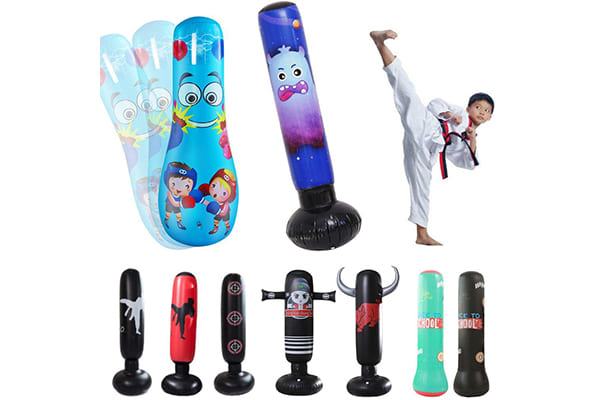
PVC punching bags have become increasingly popular among brands because they combine durability, lightweight structure, and flexible product design. Compared with traditional heavy boxing bags, inflatable PVC punching bags offer several advantages for modern retail channels.
One important benefit is shipping efficiency. Inflatable punching bags can be deflated and packed compactly, reducing transportation costs and warehouse space requirements. This is particularly valuable for e-commerce sellers who ship products directly to consumers.
Another advantage is product customization. PVC materials can be printed with colorful graphics, logos, and target zones. This allows brands to create visually distinctive products that appeal to different customer groups such as children, beginner athletes, or fitness enthusiasts.
PVC punching bags are also well suited for several consumer categories:
- children’s active play products
• beginner boxing fitness equipment
• educational sports programs in schools
• promotional sports products for retail brands
The ability to customize size, color, and packaging makes inflatable punching bags attractive for private-label product lines.
Working With Epsilon for Custom Punching Bags
For companies looking to develop punching bags or other inflatable sports products, partnering with a manufacturer that specializes in PVC and composite materials can simplify the entire process.
American Epsilon Inc. focuses on designing and manufacturing inflatable products made from PVC and composite materials. The company works with businesses around the world to develop recreational sports products, fitness equipment, and outdoor entertainment products.
Epsilon’s manufacturing capabilities include:
- custom punching bag design and development
• OEM and ODM production for private labels
• graphic printing and logo customization
• packaging design for retail and e-commerce markets
• large-scale production supported by automated equipment
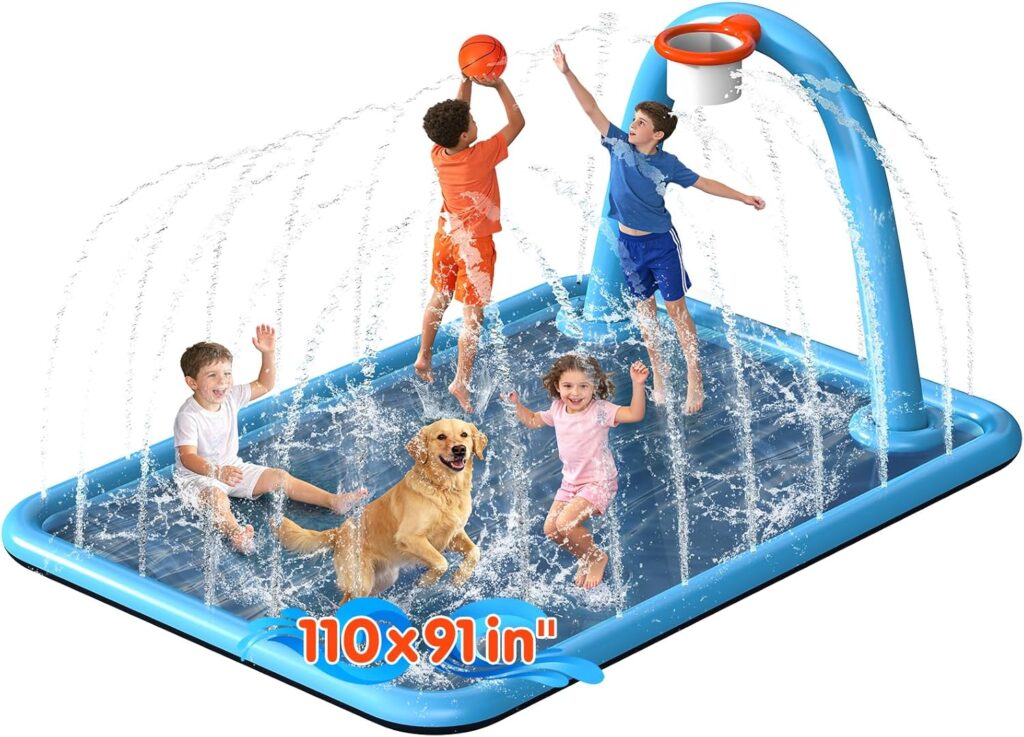
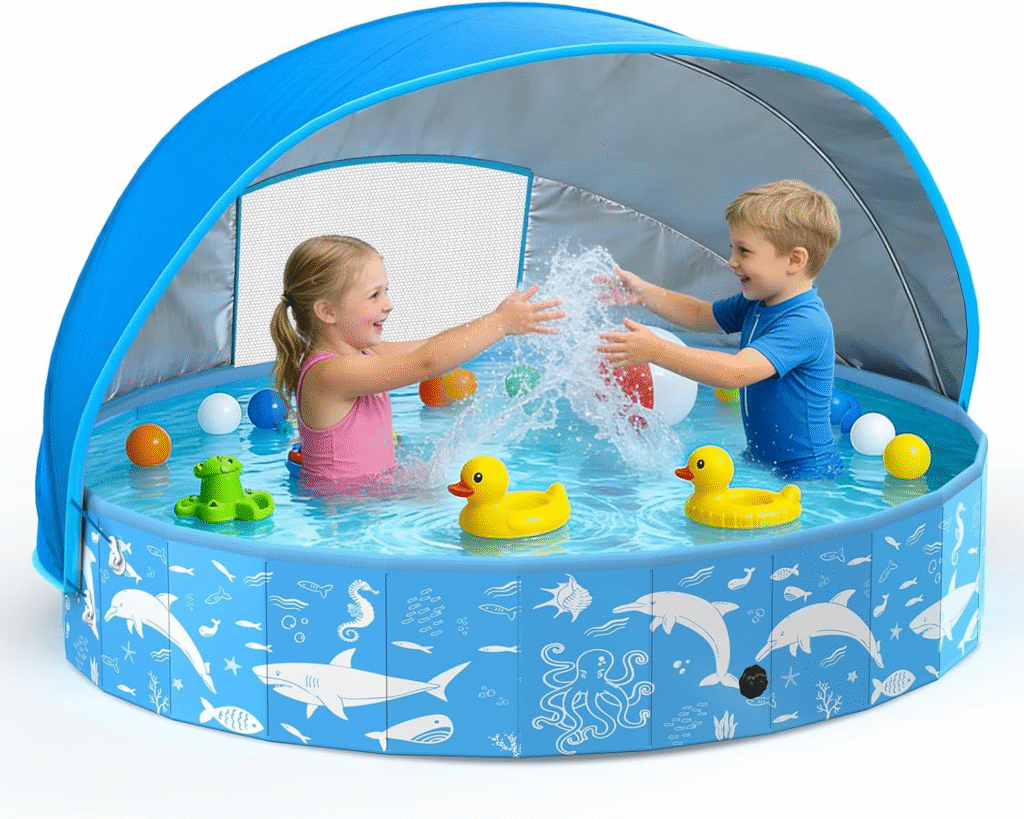
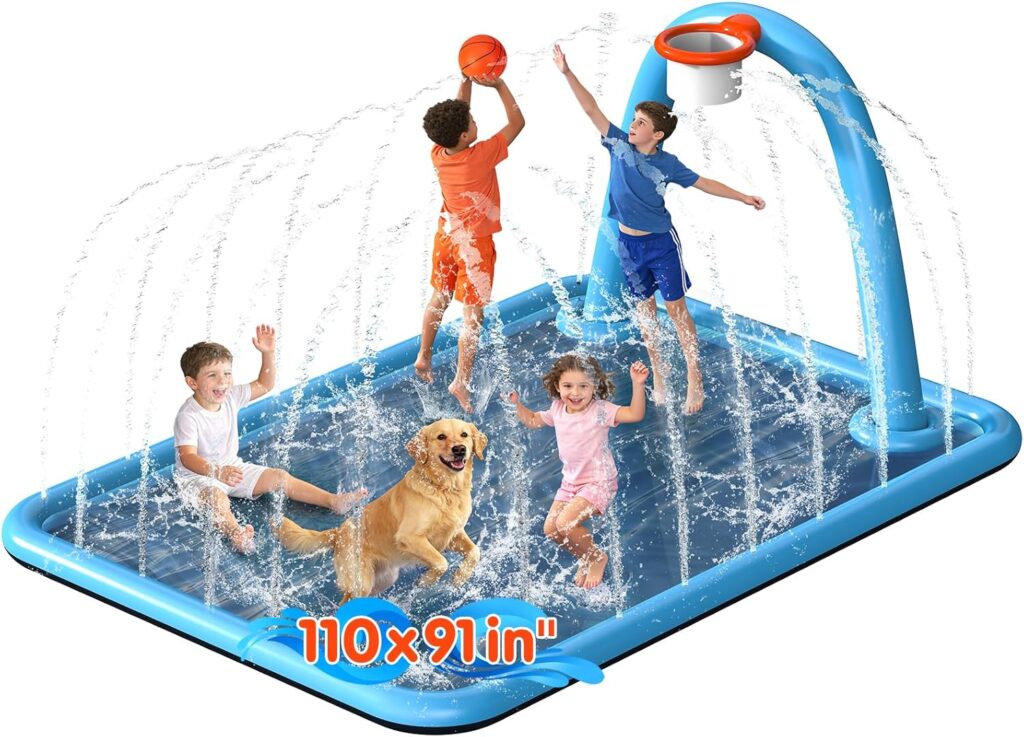
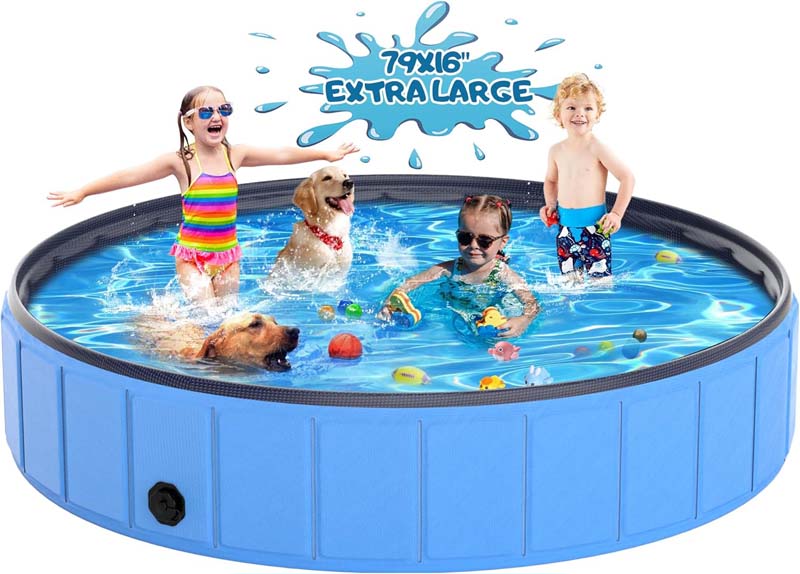
Because inflatable punching bags share manufacturing processes with many other PVC sports products—such as splash pads, inflatable pools, and training equipment—factories with strong experience in these materials can often develop new designs quickly.
Businesses that want to launch a new punching bag product or expand an existing sports equipment line can work with Epsilon to explore product ideas, request samples, and receive production quotations.
Companies interested in custom punching bags, branded inflatable training equipment, or private-label sports products can contact Epsilon to discuss specifications, pricing, and manufacturing options for their next product project.
Work with Epsilon for Custom Punching Bags
For companies planning to launch punching bags or expand their sports product catalog, partnering with an experienced manufacturer can significantly reduce development time and production risk. American Epsilon Inc. specializes in designing and manufacturing PVC and composite inflatable products, including punching bags, sports training equipment, and recreational outdoor products.
With advanced manufacturing facilities, a professional research and development team, and strict quality control procedures, Epsilon supports a wide range of customization services. Businesses can work with us to develop products tailored to their brand identity, market positioning, and target customers.
Epsilon’s manufacturing capabilities include:
- Custom punching bag size, structure, and material development
- OEM and ODM private label production
- Custom graphics, branding, and retail packaging solutions
- Rapid prototype development and scalable mass production
- Compliance with international product safety and quality standards
Whether you are a sports equipment retailer, an e-commerce brand, a distributor, or a fitness startup, working with a professional manufacturer can help turn product ideas into reliable market-ready products.
If you are interested in launching your own punching bag products or sourcing reliable supply, you can take the next step below.
Buy Ready-Stock Punching Bags
If you want to purchase ready-to-ship punching bags, you can view our current product here:
Punching Bags – Available on Amazon
Request a Custom Punching Bag Quote
If you want to develop custom punching bags, branded fitness equipment, or OEM inflatable training products, our team can help you design and manufacture products tailored to your market.
Request Product Samples
For brands, distributors, or retailers who want to evaluate product quality before placing bulk orders, we also provide sample development and testing support.
Explore More PVC Inflatable Products by Epsilon
If you are sourcing PVC inflatable products or exploring new product ideas, you may also be interested in these manufacturing solutions: